They tell me — the legends tell me, the bedtime stories tell me — that as humans found homes between dirt and sky, I emerged from an egg formed between a Dragon Lord and a Mountain Fairy.
The legends say they were never supposed to meet — the two shared few similarities, built from different worlds and kingdoms: one from the crisp, dry air of the snow-encrusted peaks in the north; the other from the bellied humidity of the south, with its structures of salt sailing through the air.
I am told from the tales I was grown on that there is an alchemy to my being. The conjoining of the mystic past with a yet unrealized future. The melding of mountain and sea. The urge built into the feet to take a new path — one so unimaginable, it feels more legend than corporeal.
Legends tend to be worn through the movement of time. The grounding of a story, passed down through whispers, stardust, and a legion of aunties, is pressed, firm and compact, until only fragments of shards remain. I can only imagine what transpired between the Dragon Lord and Mountain Fairy. I can only imagine which fragments of their origins and names found footing after seas of translations and slipped tongue to slipped tongue.
My friend Van, a fellow descendant of the eggs of the Dragon Lord and Mountain Fairy, who was named after the genderless clouds that float in the violet sun of early evening, says “All reptiles are lesbians.” This is because of a lizard species known as the Nhông cát trinh sảnm, which was first described by scientists in Vietnam in 2010; the species is known to be entirely female, and to reproduce by cloning. The scientific evidence to the knowledge I understand to be true, that descendants only come into a world of mud through their queer parentage.
I consider these origins as I reflect on my existence — one removed from my ancestors’ wings and talons. And because I believe dragons are reptiles, given their scales and ability to lay eggs, I gather that I must have descended from lesbians; fated for an existence of a certain longing only known to lullabies trembling over oceans.
My mom attempted to bring these songs over the ocean. She tried to raise me so I could speak and understand Vietnamese in the same way she did. The first time she gave me access to her language, we cuddled in her rocking chair: her cooing babytalk of sung praise, “Giỏi quá”, and I pushed my small hands to her mouth and begged her to stop. These were not sounds other mothers made.
The shame of this rejection still rings hot red around my neck. When I asked my mom about this incident, I worried about how deeply my toddler-self hurt her by rejecting the language she first understood the world through. She told me she did not hold this pain. She knew of the skins I needed to stretch over myself to be protected amidst the humidity of endless cornfields in summer, through the tearing thunderstorms of early fall, during the cracking slips of ice in the winter.
Those skins left my mouth empty, my tongue lax, until they were entirely unable to curl into the names of those I loved — my aunts, my uncle, my ông ngoại, my bà ngoại.
“Do you want to learn with a northern or southern accent?” When I started to take Vietnamese lessons in March of 2021, this was the first question my tutor asked me. Certain sounds are transformed in geography, I learned, making it a challenge to understand where another is coming from — even if the language appears to be the same. For instance: The word áo dài, signifying the traditional dress of the Vietnamese people — a shift with flowing pants for all genders — shifts from a “ya” sound (to form au yai in the south) to a “zah” sound (creating an au zai in the north). One shifted letter opens up new worlds of sound-bodied meaning.
This is what makes me wonder about the first meeting between the Mountain Fairy — throat smooth and empty from the cracking dry elevated air — and the Dragon Lord, whose mouth was either filled with ocean, water, or fire, depending on the fragment of legend. Did they, too, stumble over their own names, the formalities of each emerging stiffly from their locked tongues?
A name can be a chewy organ, gnawed down by the large molars that grow closest to the throat. The first meat of an introduction to another, then, can tie one closer to learning what a person is, beyond flesh. The syllables of your name are how you exist floating in air.
I wonder, too, how it felt for the Mountain Fairy and Dragon Lord to hold the weight of each other’s names.
Names are one of the first gifts bestowed on us when we arrive into the world. As a first cry breaks the air, the ink dries on a birth certificate with vital information — including a name.
When I was born, my parents told me my own name was more than a gift: it was a calling, an urge to move through the world with submissive gentleness and be led by those stronger than me. A perfectly colonized option.
My parents also apparently liked the alliteration my name provided: Rolling waves of r’s offered a sense of lyricality. But in this sonic composition, they failed to consider how my name would sound tucked into the mouths of my relatives. So, I was given a name impossible for my ông ngoại and bà ngoại to pronounce.
In November of 2024, certain names grew with the crushing weight of a countdown: “immigrant,” “abortion,” “transgender,” “queer.” A tightening squeeze became my body’s familiar response whenever any of these labels emerged in a headline grimly forecasting the likely future. Each and every proclamation looked equally bleak, but I could feel the protective scales of the Dragon Lord, the ancestor who has always come to my body quickest, harden around me as I was urged to do what I could to shield my community.
This is why I created an AAPI name and gender-marker change clinic with translators and legal counsel. This is when the work I was doing for my community slithered backward to face me, unearthing the question of my legal name.
My friends began to ask me, “Do you want to change your name too?” I was armed with resources, but time was limited — after the inauguration, changes would likely be tracked and potentially even denied. My response should have come easily; I should go through this process like my peers, I thought, and embody the work. To them, legally changing my name represented something gender-affirming, something sacred. A way to shed a past self.
But I knew I wasn’t quite ready to completely cut ties with my legal name.
After my Vietnamese lessons began, my family gave me their own special assignment — learning how to say their proper names. Each of my aunts had removed the accent marks from what they were called, dropping tones that tipped upward or emerged from the back of the throat, leaving behind only a tinny echo of their names. I watched as they doubled over, giggling, whenever I attempted to properly pronounce them. How could something I should be born into stretch my tongue so poorly? But each time I closed my mouth, embarrassed by my own failures, my family encouraged me to continue.
Sometimes pronunciation doesn’t matter. When a loved one — an ông, a ba, a parent, a friend — is swept up in the righteousness of love or anger, any slap-dashed combination of syllables becomes something significant. I know if someone who loves me calls to me in a strangled sound, I will still answer them. I know that these mispronunciations mean: “You. You who creates this level of passion. You, who are so loved, I know you will come if I call to you.” Through this emotion, I always know if I’m being addressed, even if the letters come out in the wrong order.
I wonder if this is how the Dragon Lord and Mountain Fairy called for one another as they first met in a mid-air collision.
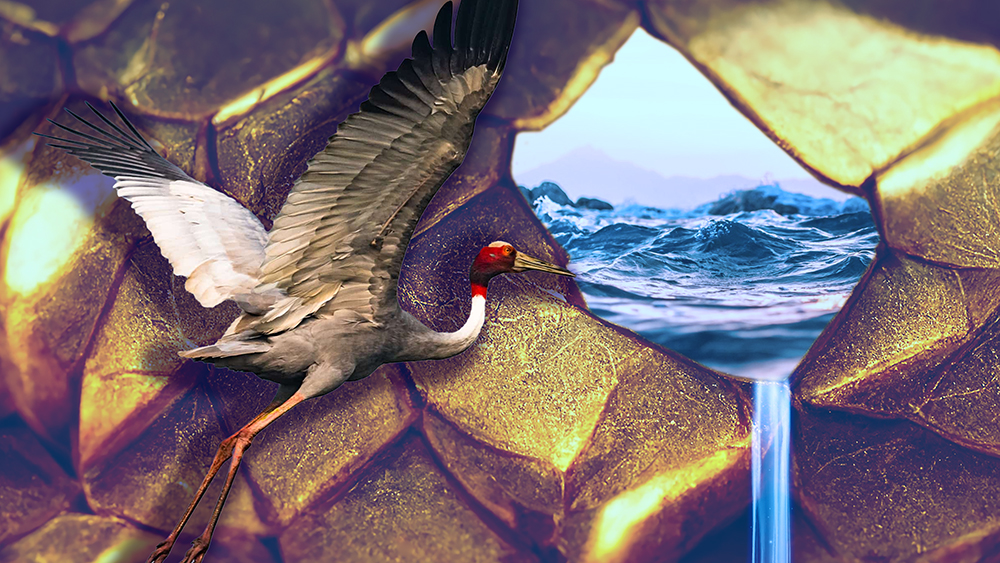
The legend says the Mountain Fairy — regarded for her tender heart and healing hands — was once summoned to help a woman birthing her first child. But the Mountain Fairy was attacked by a monster and in a startling shake she transformed, feathers bursting from her flesh, a crane replacing her immortal fairy form. She took to the skies.
The air was refreshingly familiar to her, with its bursting crystals that felt like pinpricks of snow. Her wings directed the path she cut through the clouds — drifting south, south, south — hoping her new form would offer her protection. But some hauntings are impossible to shed, even in the most thoughtful transformations; the monster followed her into the sky, looking for a way to latch onto her.
Likewise, a fear of transformation embedded itself within the syllables of my legal name.
The spell of my legal name is rarely conjured — remaining dormant, except on PayPal statements, credit card offers, and IRS notifications. Only in the most official and bureaucratic instances is my past self summoned to deal with the business of my assigned personhood. Or when I am called back to childhood through the voices of my parents who do not know me by any other name as they call me to tell me to list the names of the birds they have seen and to make sure I am alive and functioning. I understand sharing the names of birds is sometimes the only way they know how to speak to me, though I never know the birds they speak of.
But being called my god-given name was once so engrained within me that, in the third grade, I walloped a boy who refused to pronounce each letter. Teased one too many times, and tired of my name being plucked from its wings over and over again, I let my Dragon Lord ancestor take over my body: I smacked the bicycle-helmeted boy with my soft-sided lunch box over and over again. My limbs were no longer my own, wilding out of control until I could mold the world I wanted — one brought forth with the heft of a name. I continued to barrage the boy until he promised to address me in the way I demanded, the way I was told to be called. This was the first and only physical fight of my life; when it was over, I let my fists unclench and scales, talons, and fire fell from my body as my mortal form emerged again.
The Dragon Lord, whose body was built to withstand war, was also not naturally drawn to fight. They instead preferred to languidly surf through the sky when they needed a pause from humidity. On one of these floating wanderings, they saw a beautiful crane being attacked, and quickly stepped into the role they were born into: that of mythical hero and nation creator. The Dragon Lord ripped the monster apart with their jeweled claws. Then, still bloodied by battle, they wrapped themselves and the white figure of the bird in a ball of protection. Safe within the scales of her sudden savior, the Mountain Fairy relaxed back into her im mortal body, her feathers falling from her flesh and into the darkness of the sea.
Breathless and in different stages of shock, the Mountain Fairy and Dragon Lord were barely able to sigh their names in shaky whispers, instead trading exhaled nicknames. The shortest form of name, the shape of name that took the least effort to utter.
I wonder if the nicknames used that day were the ugly names their parents called them — the names that according to Vietnamese tradition would stop monsters in their tracks. In these names, did they cast themselves a spell for a future free from their fears?
My Viet friends like to tell me about the ugly names their families gave them when they were freshly hatched. These names might sound cruel to others — Ugly, Dirty, Mouse — but these brutal monickers were meant to act as talismans to fool demons and monsters. Firstborn children are often called “Two” because eldest children — boys in particular — are the most delectable. This is natural: calling one’s baby a name so horrible, monsters would become afraid of who they were, and demons wouldn’t bother to follow them as they left their homes.
Ông’s and ba’s will call their grandchildren “Bad” and “Stinky” in lilting sing-song voices. Each insult is sung so gently, the babies’ soft ears will only hear the tones of love. Beautifully unable to distinguish definitions from the calming pitch, each cooed insult coats the child in a sticky-sweet spell of protection. The intent is that the harshest thing a growing child might face is these tender-toned insults from their own grandparents.
Despite the commonality of this tradition, I was never gifted the defense of an ugly name. My father, so adamant about calling me only by my god-given name, leaving me without an inheritance of scaly armor. Why was my full name offered to the very spirits that could pinch birds from the air? I wonder if the reason for the string of unluckiness that has peppered my later life — from home invasions to smashed fingers in ancient windows to job loss to job loss to job loss — is because my given name was spoken so often, the monsters had my location tattooed onto their tongues. I wonder if I have always been as easy for them to find as their own spit.
Re-naming myself seemed to be the only way I could shed the life I was given. But stepping into naming myself felt like an act so holy, it was a daring act of rebellion. Having been raised in a Southern Baptist household, where gender roles were strictly defined and enforced, I was taught the rules of being a good wife. I was ordered that I could only be “good” if I was obedient, beautiful, and silent — all exalted from the Bible, the book from which my parents found my name. From this same text, I learned that the first-ever first name, “Adam,” was dictated by god who subsequently bestowed on Adam the power to name everything that came after him — including his own wife. Few women were named in the Bible, and each unnamed example haunted me.
Perhaps it was for this reason that naming myself felt dangerous: it went against what I was born into, revealing a desire for a different path — one that I got to create in its entirety. It was my chance to act like god. This is why providing a safe space for people to change their own names and gender-markers was so important to me: I wanted my community members, my beloveds, my dear ones to step into their power and feel like the god they might have been denied — to name themselves and have their true genders be reflected in the first documents that proclaimed them to be people. It is the Dragon Lord surfing within the skies trying to protect their people. It is the Mountain Fairy leaving her home to heal her beloveds. It is the skin I was born into.
In college, when I first began to experience the freedom to exist as a different person on the internet, I decided I wanted to step into an alternative self: someone who I wanted to be, but couldn’t be recognized as in the body I inhabited. Tired of how feminine my name was, and the direction for subservience it gave, I sought to dip my toes into something androgynous — where I was able to dictate who I wanted to be. I wanted a name that was just my own — one that only showed the lineage I was born into, and served no other purpose but a reminder of the love of the Dragon Lord and the Mountain Fairy. After discovering an article tossed at the bottom of some celebrity interview, I learned that my “power letters” were the first letter of my first name, the first vowel, and the final letter. This is how I re-named myself.
The name I gifted myself then is my name now — the one almost everyone called me: “Rae.” It became the first armor grown by the Dragon Lord, so hardened that not even monsters descending from the sky could rip into my flesh. In so doing, my given, legal name also transformed, shifting into the ugly protective name I had always longed for, the childhood spell of protection I was never granted to save me from the monsters threatening to halt my journey. This name was the name that tied me to employment, to housing, to matters of record.
In the year leading up to the creation of the name- and gender-marker change clinic, I was doing more activism work with newspaper coverage and national press attention. The spotlight was new, and its gleam had me skittering under crevices like a lizard. I disliked being so vulnerable with so many strangers, especially when someone else was writing the narrative. By opting out of the legal process to change my name, I was given an extra shield against the cruelty of doxxing, against the cruelty of being stalked, against the cruelty of others trying to stop my community work, and against others trying to stop me from loving. The monsters, like those who followed the Mountain Fairy I came from, would know me as “Rae.” They would never be able to search my legal name and retaliate.
This is where I create my own legend. I, too, have a Vietnamese name. My Viet name, like many others I know, has been smashed between colonized given names, rarely afforded the space to wander. The name lives without the pressure of protection or armor. It does not have to be the shield for my public face. It simply gets to exist as the whispered hopes of my people, while each of my public names performs a specified role: one to protect me, the other to offer my face to outsiders.
The Dragon Lord and the Mountain Fairy have real, given first names, too: Lạc Long Quân and Âu Cơ. Their story does not end with Lạc Long Quân sweeping Âu Cơ up into a future of happily ever after. Instead, they realized they each loved their own origins more than they loved each other. Together, they created a clutch of one hundred eggs. In equanimity, they divided the eggs in two, sending one to the north and the other to the south, where each could live their happiest lives, cooing in pleasure as they watched their eggs hatch the Vietnamese people.
I only say the names of my mythical parents when I feel most connected to them, when I trust myself to place the accents of their name correctly. In the memorizations of their names, they exist as the most mystical and mythical lovers. The ones who were always transforming. The ones born into heroism.
I hold the name, passed down from my bà ngoại and given to my mother, and then to me, in my hands. I bring it to my chest and tuck it as close to me as I dare when I summon “Rae” forward to act as my shield. I feel its wings fluttering against me and a weightlessness takes hold — the weightless freedom my ancestors felt as they flew together. I soar through the sky and feel like a god who can birth a new world, one where my descendants bask in the freedom of their ancestors, the diasporic, the wandering, the Viet, the queer, the trans, the earthbound gods who followed the pleasure of their origins, floating through glory of the heavens.