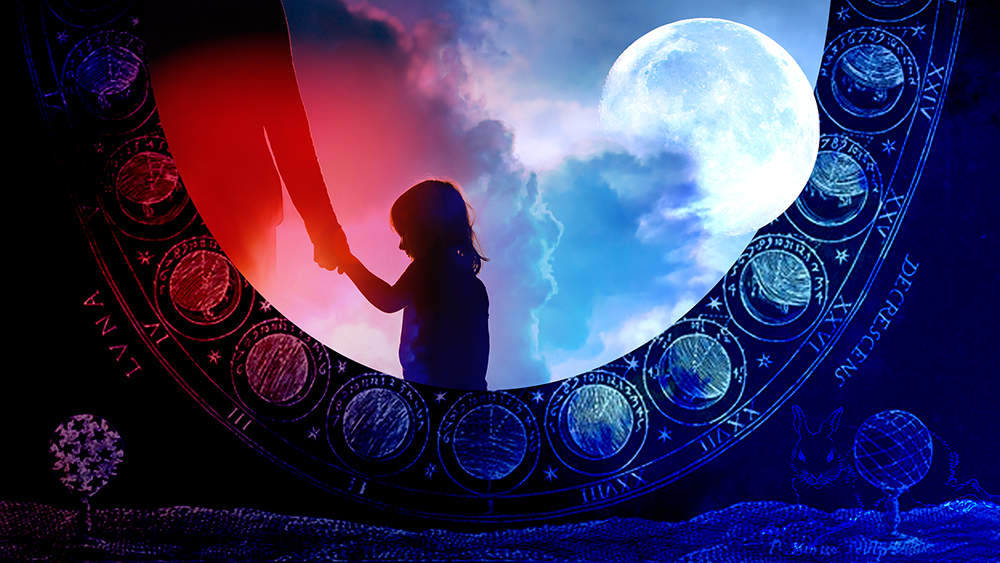
The first church I remember was a funeral home.
Shortly before my younger brother was born, my parents stopped attending the Southern Baptist megachurch where they met and wed, and my father was invited to lead worship in a newly founded Evangelical church. The congregation didn’t yet have a building of its own, so they rented a funeral home for Sunday services.
My parents always referred to the place we went on Sundays as “the funeral home,” though that meant very little to me at the time, least of all about death. Back then, my understanding of mortality was bracketed somewhere between two slogans I knew by heart and meditated on often: “Jesus Died for Our Sins” and “Drunk Driving Kills.” To me, “the funeral home” meant dim light through glass block windows and miles of dark red plush: a red deep-pile carpet, red velvet pews, and red velvet draperies (Red like Jesus’s blood, I thought to myself often with private solemnity).
We would arrive at the funeral home early on Sundays so my parents could practice hymns before service began. My father would climb the red carpeted steps to the lectern, my mother would sit on the red velvet piano bench, and, like a moth to a light, I would always gravitate toward Mrs. Livingstone, seeking her out in the dim red corridors.
I was four years old when Mrs. Livingstone and I first met, and she was well over seventy. She was also what’s commonly known as a “Church Lady”: knowledgeable about congregational happenings and dynamics, hard-working, and ubiquitously involved before, during, and after most — if not all — church functions. I cannot remember her face or the exact sound of her voice, both of which literally went over my head, but I do remember the padding of her round hips when I sat close to her in a pew, and I remember her hands: soft and wrinkled with a gold wedding ring on the left one. She was, like both my grandmothers, widowed; at my young age, I understood this to mean that she was simultaneously someone’s wife and not married. I also remember how companionably we talked, though I can’t remember what about.
Perhaps my relationship with Mrs. Livingstone was so formative for me because it was my very first connection unbound by genetic ties, arising from the mystery of human affinity. Somehow, my newly formed personality, solemn and intense, fit together with her own long-accrued, easygoing and gentle disposition like the teeth of two gears. I dreaded being made to go play with other preschoolers or to leave my seat in the pew beside her to sit up front for the children’s sermon. What I wanted was to be with Mrs. Livingstone.
Throughout my life, through the many rooms I’ve entered, through the aging and deaths of elders I’ve known and loved, beside old people (an unflattering term I falter over and then force myself to use in the name of honesty) is where I’ve always most wanted to be.
As my mother now nears the age Mrs. Livingstone was then, I find myself, nearing forty, thinking about my affinity for elders more than ever. In contrast to the ease of my relationship with Mrs. Livingstone, my relationship with my mother has frequently been difficult for us both. While some of these difficulties are the kind of normal tensions that arise in any intimate and formative relationship, others stem from divergent value systems and profoundly different outlooks on life, creating a remoteness that has persisted. Recently, I’ve wondered, guiltily: In seeking out the companionship of elders — especially elderly women — have I always been trying to find another mother? Rather than trying to repair our unrepeatable bond, have I, from the very first, been seeking maternal connection elsewhere?
And yet: My mother, when I was four years old, was in her mid-thirties; Mrs. Livingstone, aged as she was, didn’t bear much resemblance to my mother, and was older and more enfeebled than my grandmothers were at the time. Young and new to the world as I was, there were few people Mrs. Livingstone could have reminded me of, other than herself. Surely — I suspect and hope — I must have loved her for herself.
The first time I met Fran at the bookstore where we both work, my boss led me toward her, saying, “This is Fran, she works in Nonfiction.” I held out my hand at the end of a passageway, where two walls of books opened out into a wide room with a skylight above.
There, in a beam of sunlight, Fran took my hand and exclaimed, “Oh my GOD, you smell so GOOD!” I laughed in delight, no longer shaking her hand, just holding it. She laughed back and pulled me a little closer, breathed a little deeper. She was seventy-three; I was thirty. It was friendship’s coup de foudre, an immediate joyful recognition without a minute to waste. I looked into her supernova laugh lines and thought, against all logic: I’ve been waiting all your life to meet you.
Perhaps I ought to consider that my profound and instant rapport with the many old women I’ve loved since childhood is — at least in part — a cheap trick, a cheat that my cautious heart and reserved nature require to dive into speedy intimacy. After all, there is, biologically speaking, comparatively little time to spare when someone is over seventy. But what is true for the elders I’ve known and loved is a universal truth about human life, regardless of the person’s age: no fixed amount of it is guaranteed.
Yet what I fall into when I throw myself wholeheartedly into friendships with elders is not time’s scarcity, but its abundance: such abundance of time held by one individual life and body, granting intoxicating proximity to the unpromised miracle of living past seventy, an age that so relatively few in human history have achieved.
More than halfway through the summer before my senior year of college, I came out to my parents. I’d spent the last few years of my teens trying to “pray the gay away,” and the first few years of my twenties trying to make a sort of bitter peace with being closeted and unknown. When the pain of that anonymity grew too much to bear, I impulsively called my mother one afternoon and told her, through torrents of tears, that I’m lesbian. Her calm denial of this, her assertion that my sexual deviance would be solved by “returning to Jesus, your first love,” was annihilating in a way that, to this day, I do not fully comprehend.
I had been spending that summer more than five hundred miles from my parents, and was living alone the afternoon of that conversation. After hanging up the phone with my mother, I was suddenly determined not to live through the night. But by the grace of heaven and beloved community, I called a friend who promptly drove me to the ER. From there, an ambulance transferred me to the nearest psych ward, where I was admitted.
Every morning during my week in the hospital, the supervising psychiatrist would ask me if I was “ready to stop throwing this tantrum over the disappointment of being homosexual.” He, after all, had always been disappointed by being shorter than his brother, for instance, but never made such a scene about it, and now look at him: He had a Mercedes–Benz and a Big House and his brother did not! In the face of this treatment every morning, I was usually even more suicidal by lunch, which I rarely ate.
In the afternoons came visiting hour, and at every visiting hour came Joan. She was a friend of mine in her mid-sixties, and she was the very first person I’d come out to several years before. During her visits, Joan always sat in the single chair by the window of my room. From where I lay on the bed, the window gave a view to nowhere — or rather, to the inorganic splendor of an early August sky over the shores of Lake Erie. The sky was usually its brightest electric-blue by mid-afternoon and threw hot rectangles of light onto Joan’s head. I could barely see her face through sunglare, my endless tears, and the sustained glancing blows of hypomania.
Every day, Joan would remind me that there were years she’d lived through (meaning years she didn’t kill herself) simply because she’d tell herself, You can always do it tomorrow. “You hold that power,” she reminded me. “You can always kill yourself tomorrow, but why not give staying alive for today a try? The days can bring so much, but only in their accumulation. You could become an actress or a writer. You could get to hold a baby in your arms!” To Joan, there was no greater joy than motherhood — the surprise of children and watching them become themselves. But it wasn’t really the promise of what she said might lie in my future that I clung to in those afternoons.
“For the present when backed by the past is a thousand times deeper than the present when it presses so close that you can feel nothing else,” wrote Virginia Woolf, who sought and found her own death in the depths of the River Ouse when she was just on the cusp of becoming an old woman. Over the years, many people have given me reasons to let myself age, and almost all those reasons have been good and true. But in the week that I came closest to cutting my life short, Joan, speaking to me so frankly from her own accumulation of time, was the only one I found myself able to trust.
Job, the King James Bible relates, died “old and full of years.” So, too, in that exact turn of phrase, did Abraham and Joshua. The Christian Scriptures, especially the epistles written by anxious new Jesus followers who lived during what they believed were the end of days, are cluttered with the word πλήρωμα, “pleroma,” often translated as “the fullness of time,” another way of saying “the meaningful end.” The end, thought the early Church, was when things finally happen: the Messiah comes, Empire ends, and a divine narrative arc reveals itself.
The geologist Marcia Bjornerud writes of the human (especially contemporary Euro-American) terror of time’s vastness, a fear she terms chronophobia and links directly to Christianity’s end-times fixation. She insists that looking to rocks, stars, and deep time can be an antidote to this fear. Our supposed virtue of “timelessness” is, by definition, an empty one, she argues. What is worth cultivating is timefulness, which offers a better description of what this world we inhabit actually is: time-full.
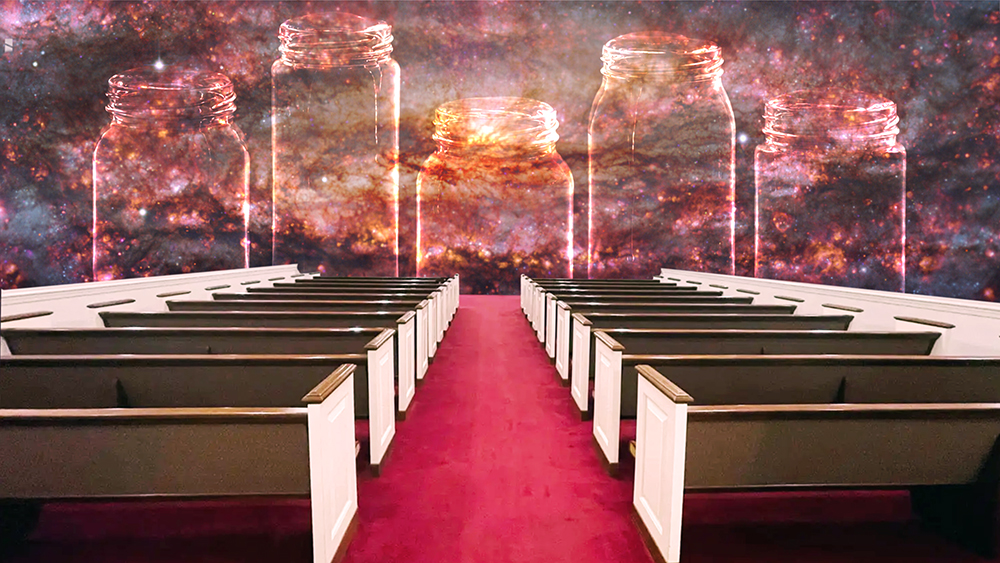
When I think of the elders I love (those still living and those long dead; I love them equally), I think of jars filled nearly to overflowing, of deep pools I could safely dive into headfirst without reaching the bottom. Never once have I thought of an hourglass with just a few grains of sand left.
I listened again this afternoon to a voicemail that my dear friend Dianne left me more than seven years ago. In nonchalant succession, she reveals she has ovarian cancer, then welcomes my wife and me back from our honeymoon (“Did you both go?” she asks sweetly: perhaps my all-time favorite example of old dykes trying, with loving bewilderment, to comprehend big weddings and honeymoons or young queers’ embrace of what she otherwise called “Straight People Nonsense”).
I met Dianne, a retired nun, in the little side chapel of St. Luke in the Fields, the Lower East Side church where I started my tentative rapprochement with Christianity in my mid-twenties. She was lying on her back beside the altar on a mat that she carried everywhere on her mobility scooter, a posture necessitated by a spinal injury from decades before. She was the oldest, proudest lesbian I’d ever met and was passionately devoted to God. Sometimes, while driving her wheelchair along the path by the Hudson River, or in the many hours she spent in bed because of her old injury, she had visions in which the heavens opened and God spoke to her. God-as-revealed-to-Dianne was magnificently technicolor and said things like, “Your lesbian love is a blessing.” Dianne spent years after leaving the religious order in which she both served and was abused bearing witness to the knowledge of her own blessedness, painting hundreds of rainbows and portraits of the Virgin Mary holding out her hands, many of which are now held by the Lesbian Herstory Archives.
Dianne ends this particular voicemail, “Like St. Julian said: ‘All shall be well and all shall be well and all manner of things shall be well.’” She was closer to her own death when she spoke those words than I am to it now, when I listen to them.
Time, which filled Dianne to the brim and spilled over, is, in that particular form, now gone, taking me farther and farther from her. And still, because of how she lived her own long life, I sometimes almost believe her, that all shall be well and all shall be well, that all manner of things shall be well.
I decided, very late in the process of becoming a mother, not to. After two years of talking and dreaming and anticipating, after tens of thousands of dollars, reams of paperwork, nights of soul-searching and careful study of dozens of personal and sociological papers; after a pregnant woman was ready to commit her future child to my wife’s and my care, when a crib stood assembled in the room next to mine, I looked down the barrel of my planned future, pointed loaded at my heart, and said: I cannot do this joyfully or honestly; nor can I do it in good conscience.
My decision was founded on many logical arguments, but also on some deep instinct that I still can’t fully articulate. Alongside my honest reckoning of my wife’s and my debt in the face of the increasing cost of raising children in this country, the limiting fatigue and pain of my chronically ill body, and my growing qualms about the racialized capitalist dynamics of the private adoption industry, there was a realization of how much less available I’d be as a mother of small children to the elders in my community for whom I can currently drop everything to cook or drive or garden or go to the doctor or to just show up and sit under a tree and talk. I did the calculations and could not willingly accept the likely result.
But while my choice may seem somewhat out of the ordinary, it is hardly remarkable or laudatory. Millions of people stretched beyond breaking do both, every day, all over the world: they raise children they chose or did not choose to bear, keeping them alive with criminally scarce resources, all the while addressing, with great love — or perhaps just great endurance — the illness, disability, and needs of their elders. Or they flourish multi-generationally in networks of care that are larger and more durable than nuclear families.
It is in this vein that the all-too-frequent refrain “Think of the children” haunts me. I want to say, Oh, do I ever — so often and with such agony — especially of the children I personally love; of copiously legislated-against-and-objectified gender-nonconforming youth; and of the young victims of violence, greed, and conquest whose mutilated bodies I see photographs of on the news every morning.
But sometimes, surely, isn’t there something manipulative lurking beneath the veneer of this plea? “Think of the children” can too easily come to stand in for: “think of your investments,” “think of your legacy,” “think of your own need for care in old age,” and even “think of your chance at immortality.”
For different but equally essential reasons, I am committed in my resolve to think of the elders. And while there is certainly an element of reverence, gratitude, and even indebtedness — especially for queer elders — in my line of thinking, there is also a bracing mixture of profound independence and deep interdependence. In loving old people, there is no legacy in question for me to leave behind or obsess over — and no vast futures for me to shape, given that these people have already lived the majority of their lives before I ever met them. And yet each of them, like all of us, live somewhere along the spectrum of infirmity, all of them moving visibly further and more permanently into disability every day. All of us, moving nearer to death in the pursuit of living our fullest lives.
My wife and I met Sylvia in line at a book signing about seven years ago, and struck up a conversation with her that has never really ended. Sylvia and I call or see each other at least once a week and share grief for our burning, warring world and also our shared resolve to keep building something better, alongside our observations on the books we’re reading and details of our gardens and all the lifeforms with which we share them.
In recent years, Sylvia has initiated more conversations about her aging body and dwindling mobility, and my wife and I offer more frequent practical help with things like car rides and groceries than we used to. While our dynamic increasingly mirrors that of many elder parent/adult–child relationships, I always feel, first and foremost, that I am Sylvia’s comrade. Together we are exploring one of friendship’s rooms that few people get to unlock, or a deeper depth in friendship’s ocean than many ever dive.
In the playful spirit of this friendship, when she’s up to it, Sylvia loves to drop things off at our house in secret. She comes when I’m away or even creeps up quietly when both my wife and I are home, so stubbornly insistent to not disturb us that she manages to leave seedlings, a jar of jam, the summer’s first gardenia, and once, a tube of sunscreen on our front porch without even our hypervigilant dog noticing.
Sylvia always leaves a note with her gifts. Sometimes, the notes are written on the back of ephemera from her decades as an anarcho-lesbian ecologist, horticulturist, and activist. My favorite of these was tucked into an empty egg carton on our porch back in 2020 when we kept ducks and gave their eggs away to everyone we knew. Where someone else might have used a Post-it, Sylvia wrote the date on the back of a photo in ballpoint pen along with the message: A blast from the past — with smiles. Thanks for the eggs!
The photo, framed now on my desk, must be from the early 2000s — probably from the early days of the War on Terror. In the picture, a crowd of people bundled in hats and heavy coats moves under a dull gray sky. I imagine Sylvia behind the camera because she isn’t in the photo, though some other elders I know are. In the photo’s foreground, a group holds up a big purple banner reading “Lesbians Gays Bisexuals & Trans for Peace.” Nearly every face in the photo is bright with laughter. One person waves a flag printed with a picture of our blue-white-green Earth as seen from space. Across the largest banner flies a dove.
Years before same-sex marriage was legal, here are queer people, shoulder to shoulder in the street, marching not for their own access to a privileged legal familial status, but for the whole world, against war.
For several long minutes this morning, in the present hour of industrialized genocides waged with my tax dollars and threats of state violence close to home, I cast my gaze down into this photo, like lowering a bucket into a deep well. I drank in all I could draw up, and, while I didn’t leave completely filled, neither did I go away empty.
“What do you think it’ll be like when you’re finally an old woman?” my wife asked me the other day. “And when I am? Will you love me even more? What will you do when you can no longer be friends with people twice as old as you are?” I laughed along with her. I held up my open hands, empty of answers.
What I do know is that no relationship structure guarantees care and safety at every moment we will need it — neither through involuntary genetics nor conscious choice, through partnership or friendship, through being parented or parenting, nor by the grace of fresh starts or the comfort of old ties. But I am amazed by all the ways and places I’ve been able to find and offer care in this life. I’m willing to take the risk that, as long as life continues, so, too, will all this tenderness.
Coming to love Fran through the hours that we spend working at the bookstore together every week also meant meeting and loving her husband, Rob. Though five years her junior, he was in dwindling health when we met, and, as the years passed, was frequently in and out of the hospital.
Last October, Rob stopped swallowing. He was unhooked from every IV, taken off every medication, and transferred to a room overlooking Lake Erie in hospice care. The view from his bedside was all water, all the way to the horizon, water for miles.
The night before Rob died, I sat at his bedside so Fran could go to dinner with her stepson and daughter-in-law. They left for the local pub in a howling windstorm. The dark air leaping at the window was filled with water, a mixture of rain and surf. One small lamp lit the corner of the room farthest from where I sat holding Rob’s hand.
I sang lullabies, working my way through every gentle song whose lyrics I know by heart, leaning close and staying soft-voiced. In rooms up and down the hall, other people were also dying.
After about an hour, my repertoire dwindled, and I found myself singing one verse of “The Water is Wide” again and again. I paused between repetitions to listen to rushing air — the keening wind outside, the rasping of Rob’s last few breaths beside me. Then, once more, I’d dive into that loveliest stanza of that loveliest song:
There is a ship, and she sails the seas
she’s laden deep, as deep as can be
but not so deep as the love I’m in
I know not whether I sink or swim.
Almost exactly one year before Rob died, on the first night of a trip to Maine to celebrate Fran’s birthday, we opened a bottle of champagne in the fading evening light.
My wife pulled down glasses and we filled all six to the brim, standing in the kitchen where my wife and I, Fran, and three of Fran’s other close friends had just finished unloading groceries. “To Fran!” we all cried. “To eighty more years!” I added. Everyone but my wife groaned. Everyone in that room (except for my wife and I) was over seventy-five. “Only someone under seventy would say that!” scolded one of Fran’s friends. Fran laughed and pulled me closer into her arms.
Silly, greedy girl. More — I want more. I’m trying to learn when, sometimes, enough is actually enough.