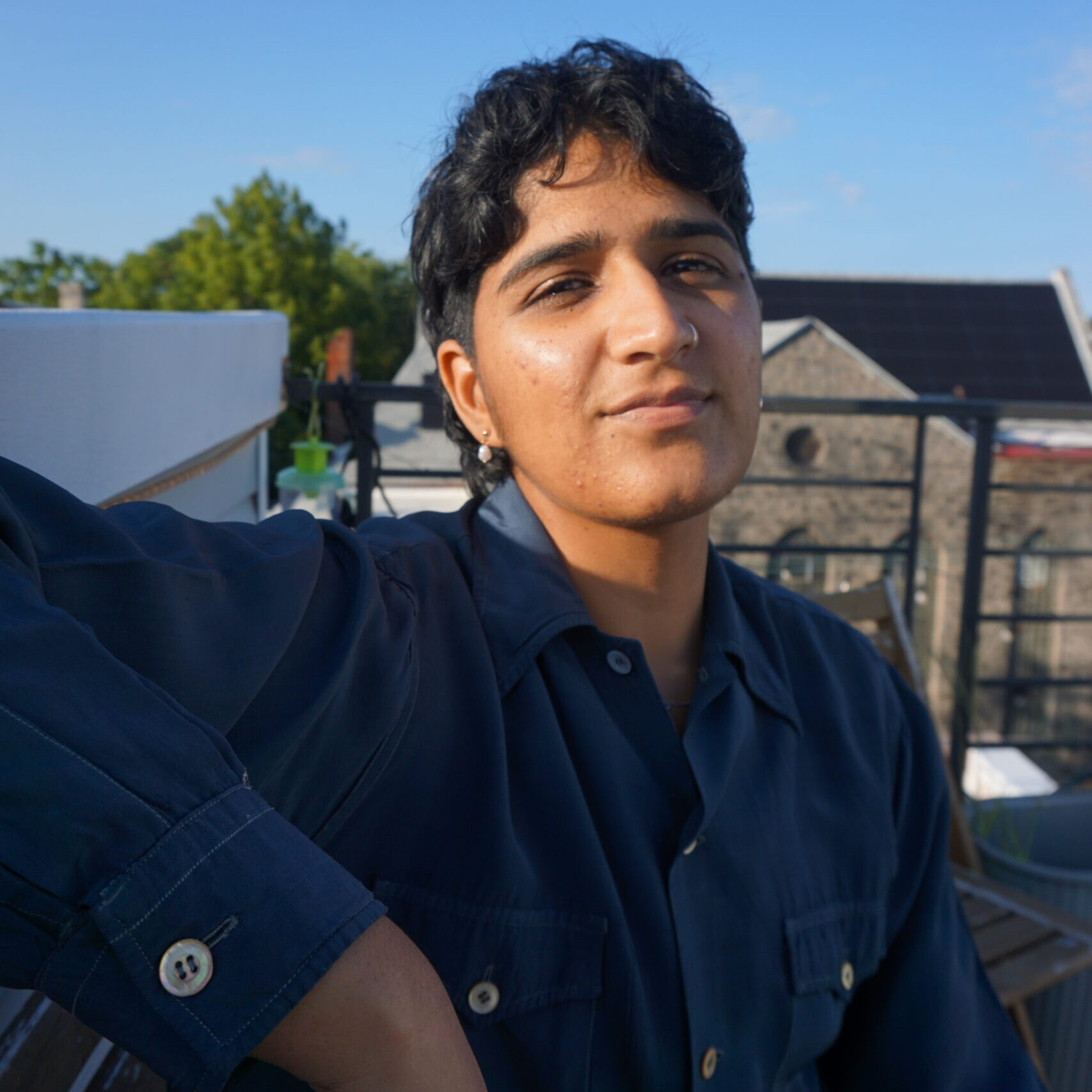

Editor’s Note
I will begin and end in reverence to language, for it is our ferry and our failure.
The prefix trans comes from Latin and means “across, beyond, through, on the other side of”. It is a signifier of movement, of passage, of change. When I think about this etymology in step with words like transgender and transnational; words that, for me, are lived experiences, I begin to consider the implications that arise when a state of movement is a state of being. What happens when the in-between is the place you come from, live in, and carry with you?
I then turn to other renditions of this morpheme: transform, translate, transcend, transfer, transport, transit, transmit, transfigure, transmute, and so forth. In each of these words is an energy that refutes rest, that is continuous in perpetuity. The voices in this anthology hum with the same power. They invite me to feel deeply into the intricacies of immigrant experiences, queer and genderqueer realities, bilingual and trilingual lexicons, the thin veils between life and death, home and away, belonging and longing, empire and intimacy. Through them, I arrive back at the word liminality for the way in which it speaks to the ongoingness in the lives of those who inhabit the spaces between and beyond spaces.
The word liminal comes from the Latin word limen which means threshold. I first meditated on the idea of a threshold in a workshop led by Divya Victor—poet, essayist, teacher, friend—who pushed my thinking forward to consider the threshold not as a bridge between two places, but as a place in and of itself. My experience of liminality—not neither here nor there, but here and there—was given a new word upon which it could lean. This credence sparked my curiosity for the voices of those who join me in such plurality; whose thresholds look, feel, sound, smell, and taste much different than my own, but name me kin nonetheless.
This anthology set out to bring forth the nuanced complexities and beauty of stories that resist category and make no apology for bleeding beyond the lines.
The voices I encountered in the process of its curation restore my faith in language’s capacity to tether us to each other’s truths. Where words fall silent, that same energy and vibration of movement pulses through. May it move you as it has moved me.
Table of Contents
What’s inside “On Liminality”? Editor-in-Chief Sanam Sheriff describes each piece that is in their anthology.
Precious Musa’s poems queer the sentence into lyric so that we may look down the long corridor of spirit, break bread with grief and love.
The entirety of Ajith Thangavelautham’s short story, “Marvin Cries About The Dying Earth,” takes place in the liminal space of a moving car. Inside it we encounter a narrator whose lens reframes what is masculine, what is queer, what is heritable, and what may never be known, laced over the music that makes it heard.
Aishvarya Arora writes with lyrical precision—ear pressed against the music of the line—so that we may travel with them, and with these poems, to the interior, the erotic, and the ineffable.
Qurrat ul ain Raza Abbas has written a mountainous lyric essay that leans on Arabic’s twelve gradations of friendship to paint a portrait pulsing with love, yet heavy with blood. We move from Karachi to Gilgit-Baltistan, to the mountains of West Virginia, to Palestine, all the while considering what a border can make of kin.
Mahru Elahi’s “Passing: A Softball Tale” is an essay that braids history with memory and the poetic eye with a storyteller’s voice so that we may journey into the life of an Iranian teenage girl living in early 1980s California, straddling the line between being known and being.
In this personal essay, Janika Oza renders the writer’s page into a liminal space between the living world and her ancestral kin. Tracing lineages of displacement, naming, love, silence, and grief, she offers us a new kind of map.
Between the face of genocide and the face of the divine is a phone screen held by a daughter who is also a mother surviving her own history. Zara Chowdhary’s poem-in-two-parts holds up a mirror to our broken world, and a window to our faith.
Through dappled light, glistening woods, and a whistling dark, we walk the length of Taylor Johnson’s voice as his poem delivers us into the space between here and gone; asks us, with a little music, to linger.
And you can see an artist statement by featured artist Udeshi Basu.
Close"On Liminality" original call for submissions
This is the call for submissions, which is what the published contributors submitted work toward:
Often, when we think of the liminal, we conjure in-betweenness, a period or phase in which we are neither in one state nor the next, but in transition, intermediate. This anthology invites you to consider the in-between as multitude. Not “neither here nor there,” but here and there. The poet and writer Divya Victor urges us to approach a threshold not just as a bridge between two places, but as a place in and of itself. I extend that invitation to you.
As we witness the unveiling of a far-right, xenophobic ideology on a global scale — one that relegates in-betweenness to the margins — this call centers an expansive framework of the liminal by inviting queer, trans, and immigrant writers to the fore. How do the pluralities of body, place, state, love, shame, lineage, loss, longing, and belonging translate into your work? What does it look like to stretch the bounds of language and genre to hold such an expansive articulation?
This anthology is eager to engage with practices of trans poetics, the queering of english, and the hybridity of transnational lives rendered into lyric and sentence. What if liminality is the place we have arrived to, the place from which we now speak?
Close