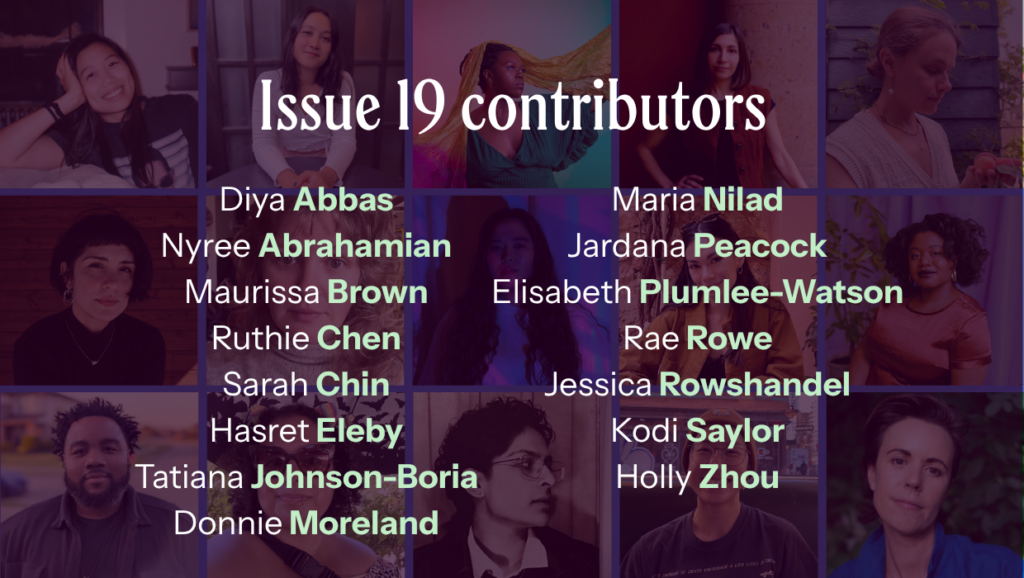
Editorial Note: In June 2026, we published Issue 19: Little Changes. Each of the 15 incredible writers, artists, and activists below worked closely with our editorial team through a three-month process to get their piece(s) in tip-top shape. Below, you’ll find some words from each of our editors about the pieces they worked on and what struck them most about them, and why this work is so important in the world today. We’re incredibly grateful to our editorial team for their keen eyes and thoughtful attention; you can experience the issue in full here, as well as each contributor’s piece at their specific link below.
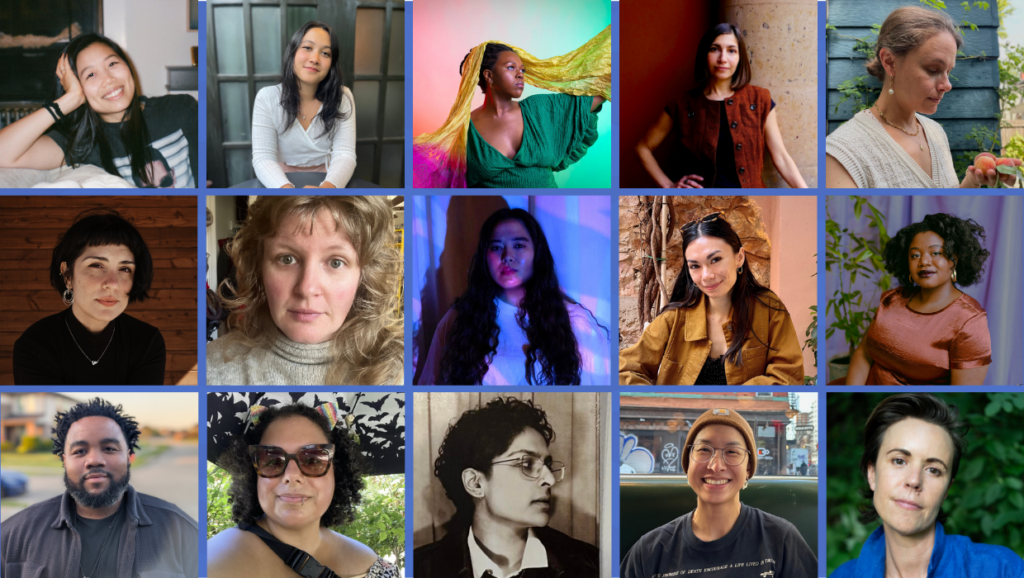
Middle left: Hasret Eleby, Kodi Saylor, Rae Rowe, Sarah Chin, Tatiana Johnson-Boria.
Bottom left: Donnie Moreland, Jessica Rowshandel, Diya Abbas, Holly Zhou, Jardana Peacock.
Ruthie Chen’s “Post-Mortem • Pre-Mortem”
“Ruthie Chen’s work engages with the world through a camera obscura, recasting our political realities through fresh personal lenses. Both ‘Post-Mortem’ and ‘Pre-Mortem’ reflect on the gendered politics of loving, while pulling apart love’s lived life. I was most drawn to how playful these poems are, how repetition in Chen’s work is a rising crescendo that mirrors both falling in and falling out of love.”
— Stuti Pachisia, senior poetry editor
Maria Nilad’s “Every Time a Freedom Fighter Dies”
“Stunning. Pure art. I was so taken with this poem, it has beautiful eco-poetry roots to it as our view encompasses seeds, microbial life, the harvests of many gardens in the setting of the vegan market. In sitting with this poem I have gone back to many Civil Rights and other freedom fighter photographs, and that tempered resolve for justice shines through here in this piece. I love how Nilad interprets and offers this inevitability, not as a dark and harrowing concept that will leave our world a barren wasteland, but with equilibrium of humanity and the natural world.”
— Elizabeth Upshur, poetry editor
Maurissa Brown’s “one day, we won’t have to hold our breath”
“Maurissa’s piece uses text in a way I’ve never seen before, playing with the rhythms of news coverage and internal mantra in order to steer or stutter a reader’s attention. Her writing braids nonfiction and poetry in order to look anxiety in the eye, and reach a new understanding of how the regulation of our nervous systems and the regulation of our climate are linked.”
— Jeff Joseph Katz, assistant editor
Nyree Abrahamian’s “When to Eat a Persimmon • Catching up”
“Nyree Abrahamian’s work places the reader in the center of her heart and homeland, utilizing the intimacy and impressions of brief scenes to capture what shifts — and what endures — far beyond those singular moments in time. I admire how these pieces invite us in with tenderness and deliberate imagery. Both poems locate themselves in Armenia, guided by a conversational approach that brushes against the surreal.”
— Kathy Jiang, poetry editor
Elisabeth Plumlee-Watson’s “The Fullness of Time”
“In Elisabeth Plumlee-Watson’s ‘The Fullness of Time,’ reflection, investigation, and speculation collide. The result is the unearthing of a fateful change in perspective that ultimately leads Watson down a road of redefining the limitations of life, the meaning of a purpose-filled existence, and the ways in which we might find and form future families.”
— Briana Gwin, senior prose editor
Hasret Eleby’s “The Space Without Name”
“Hasret Eleby’s prose embodies the past’s persistence in the present and the present’s seeming inextricability from the past. What drew us to ‘The Space Without Name’ is the honesty with which the author portrays the tug-of-war between the love of family and the authentic pursuit of love and desire. Hasret’s searching, illuminating, consistently surprising language attests to the persistence of love, desire, and the belief in the eternal in the face of circumstances that conspire to refuse their existence.”
— Jules Chung, prose editor
Kodi Saylor’s “Three Memos”
“Kodi Saylor’s poems come from a packed inner world, whose drama is revealed through the memo form. Kodi manages to transform the mundane into the magnificent, within the short, specific form of the memo. We were delighted to discover Kodi has long been working on a full collection of these memo poems: little records of full life.”
— Stuti Pachisia, senior poetry editor
Rae Rowe’s “Letting Names Grow Wings”
“Rae Rowe’s braided narrative moves seamlessly between their ancestors’ origin story and their own embodied and politicized reality. Queerness bridges the gap between then and now and pulls us along with Rowe’s journey through language and naming. I was captivated by the lyricism with which Rowe chases the elusive spell of a name, and how they illuminate the gifts and consequences of the act itself.”
— Naomi Day, prose editor
Sarah Chin’s “All of Your Dreams Are Evidence of the Web That Holds You”
“Sarah’s Chin’s poem drew me in with its magnificent storytelling. Theatrical and playful, each line in ‘All of Your Dreams Are Evidence of the Web That Holds You’ considers a moment of life lived in high anxiety. Chin draws out the tension of these moments with a quiet certainty that you keep returning to. This poem can be read six ways, and each way reveals new meaning.”
— Stuti Pachisia, senior poetry editor
Tatiana Johnson-Boria’s “Gentle Parenting”
“Tatiana Johnson-Boria’s essay takes as its starting point the complex freedom of a child’s body, and expands outward with kaleidoscopic scope to trace the legacy of bodies through her own family. I was captured by the clarity with which Johnson-Boria illustrates her own understanding of love and abuse, and how she compassionately and humorously demonstrates both the joyous and trying nature of parenting.”
— Naomi Day, prose editor
Donnie Moreland’s “the big payback • Mrs. Tubman’s toes”
“Working with Donnie has been an absolute joy. From the moment this came through in the reading queue, I loved the way he interpreted the idea of Little Changes to execute his vision, particularly of humanizing Harriet Tubman as a fully realized, sexual being. This felt like such a love letter to Black womanhood and as a Black woman myself, this was an honor to assist in curating.”
— Elizabeth Upshur, poetry editor
Jessica Rowshandel’s “Number Line • The roof”
“Jessica Rowshandel’s work takes account of the following: life and death; what is inside and outside of our bodies; and those who do and do not help, who do and do not bear witness alongside their speaker. I am moved by how these poems manage this quietly insistent voice of observation: before you know it, together, the speaker and the reader have been pulled through cascading moments they ultimately cannot look away from.”
— Kathy Jiang, poetry editor
Diya Abbas’ “Verbicide • Autopoiesis”
“What a talent, what a force! Diya’s ability to layer striking apocalyptic visuals alone, that white horse still canters in my brain! Moreover, her concise political commentary and starting point of individual linguistic power in such a short amount of lines is incredible and makes for a stunningly resonant poem.”
— Elizabeth Upshur, poetry editor
Holly Zhou’s “Thirty Sonic • again & gain & in &”
“Holly Zhou’s poems play with allusion, form and space to reveal an inner yearning for a better future. We paired ‘Thirty Sonic’ and ‘again & gain & in &’ because they demonstrate Zhou’s vast stylistic range, which draws from Sophie Xeon’s musical production to political censorship in China. I was taken by the intentionality in Zhou’s work, where gaps and blank spaces mean just as much as the sounds and words on the page.”
— Stuti Pachisia, senior poetry editor
Jardana Peacock’s “Almost Home”
“Jardana Peacock’s essay blooms outward from a single image — that of an elusive, nocturnal flower opening — into a time-bending reckoning with lessons from a past confined by heteronormative expectations, visions of a queer future centering mutual care and community, and all the promise of the current moment.”
— Briana Gwin, senior prose editor
Please join us in welcoming these 15 voices into the Seventh Wave fam, and be sure to spend some time with each piece over at The Magazine.