In Celo, I spent my evenings on a porch waiting for a night-blooming Cereus to open. I was house-sitting in North Carolina, 362 miles from my home in Kentucky. My responsibilities were dreamy: water the raspberries, pick the ground cherries so they won’t rot on the earth, turn the sprinkler on in the greenhouse where angel trumpet flowers and giant kale scale the walls, and maintain the saltwater lap pool. The rain lulled me to sleep at night, the round creek rocks arched my feet as I balanced across the water, and bluebirds streamed through the meadow. In Celo, life slowed down.
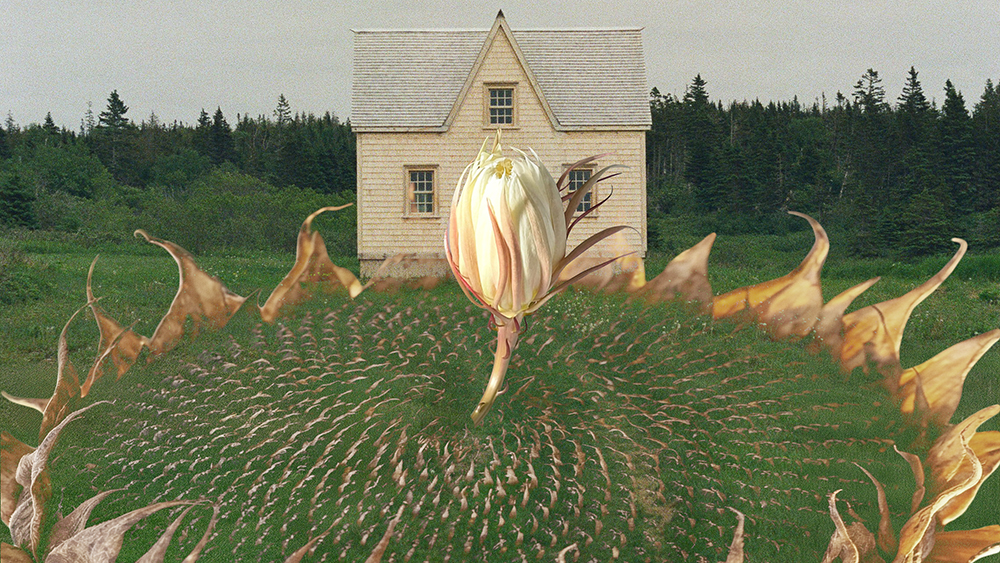
The homeowner’s Cereus plant grew on the outside deck. Its wide, flat leaves were like octopus arms growing oblong blossoms. Cereus are monocarpic, desert flowers that bloom only once, a common survival mechanism in plants originating from harsh terrains. I wanted to witness the Cereus bloom, and for that bloom to be a promise: You will find lasting love, because in the damp wonderland everything seemed possible.
Two years had passed since I separated from a cis-het man who was the coparent of our children. In an arrangement not queer enough, I had lost myself. Outside on the Celo deck, across a white enamel table, I assembled an altar on a silky yellow cloth. I placed a round silver bell, shells, and a candle on the fabric. In its center lay a collage of what I wanted: a family, a partner, space to write, time to travel, a more connected queer community, and a home in the mountains like the ones that surrounded me. I closed my eyes and tried to imagine what I thought was possible. An image of a different porch materialized, with two people drinking coffee as a pink mist filtered through the nearby forest.
In my vision, I later fed the woodstove from trees we split into kindling. I wanted to grow old with the kind of partner who would reach for my hand before pressing a kiss to my cheek. Our chickens would scratch in the grass as our one rooster crooned. My partner would be someone who cared about the lesser-loved creatures of the valley like snakes, slugs, and spiders, who knew how to fix broken objects with their hands — a roof, a chair, a sink — and cultivated curiosity about the world like a child who had just observed an alien passionflower for the first time and proceeded to learn all of its parts (stigma, nectary, awl) before sharing about them to anyone who would listen; someone who was committed to nourishing a place’s soil but also tending the roots of community care.
This shared life I imagined was one of laughter at crowded dinners, board games, and tea in the grass with the littles, surrounded by magical and radical trans and queer communities. Our kids would roll tubes to the river for afternoon creek rides. I wanted to feel the powerful pulse of queer family rooting against the hardness of the world’s violence, to know we would hold each other in pain and grief and remain steadfast and tender in our fierce and vibrant survival.
On my second day in western North Carolina, I met a microbiologist for a date in Asheville, an hour away from my temporary wonderland. I wore cutoff jean shorts, black suede boots, and a blue button-down with tiny lightning bolts. Since my separation from my husband, I approached dating like a numbers game; most new connections felt like a chore to establish, yet I continued showing up, hoping to one day be surprised. Despite my conjure the night before, I wasn’t prepared.
The Microbiologist was a cute, white, soft-masc kind of queer who was definitely my type. They walked with confidence but also kindness. After coffee, they led me through the Asheville Botanical Gardens. They named the plants we passed, the birds as they tweeted. This is a person who knows about the world in ways I do not, I thought. Here is a person who makes my body feel calm in ways I usually do not. I was used to carrying the conversation by instigating banter and performing enthusiasm, but this time I abandoned my usual role of facilitating connection. My steps planted on the path, my shoulders feathered down my back, and I relaxed in the summer humidity, cataloging the bird songs I usually ignored.
We walked to a bridge and leaned against its weathered wood. A warm swirl entered my pelvis, shot up my spinal column, and exploded like ferns unfurling into my thalamus. I was physically on that bridge next to them, but also in the future because I already knew there would be one for us.
When the garden tour concluded, I drove back to the house in Celo and the Microbiologist texted me asking if they could see me again later that night. I invited them over for dinner. After they parked and closed their car door, I asked if they wanted to see the greenhouse. They smiled and touched my arm in response.
“Your skin is soft,” they murmured, ignoring my question.
“Coconut oil,” I said. Soon we were inside the house’s guest bedroom, cream-colored sheets glowing and shapeshifting with every roll of their strong shoulders, lifting my body across theirs. The scent of their Dr. Bronner’s almond soap massaged into my inner legs. Cool air welcome on our hot slick limbs. Waterfalls over thighs. In the gray filmy light I peeled off their red T-shirt. My hands were impatient. I yearned for a new promise in this moment, of what two bodies, two people, could be to each other. Their slender hand moved into my underwear and inside of me. Home.
So began our lovership: Days with the Microbiologist turned into months. Our paradise traded places between North Carolina and Kentucky. Our connection was rushing water after a rain. During sex, I saw mountain ranges, our body movements like steam rising from hot rocks.
They made me a parrot key for my North Carolina visits. In their apartment, I heated up their leftover coffee on the stove as my bare feet suctioned to the tile floor. I texted them while they were at work, imagining them taking students through science lab protocol, their eyes shielded behind clear plastic goggles. They wrote me back, I love you. Make yourself at home. You are my home. I love coming home to you. I felt the same.
I experienced queerness as a sensation of full-body awareness, a wholly present state. It was as if the barriers between the elements, people, and the more-than-human world dissolved, and this, I understood, was because the complexity of interconnection was queer. The weeks we were apart, they often knew at which point in the day I was sad or distressed. They would text me, Are you okay? It was both comforting and scary to be known on this emotional level.
In bed one morning after six months of lovership, the Microbiologist lightly traced my body. “I want to be a bigger part of your life,” they said. I had been hesitant to invite them into my reality as a parent. Our first month together, they had shared they never imagined having kids. While our connection felt blessed, it also felt removed from my other life: I thought very little of my children as I was falling in love with the Microbiologist. I had wanted so much to secure a love like ours permanently that I had told myself I would sort out the complicated details later.
“Really?” I said.
“Yes, I want to know all of you.” I had not realized it until they said it, but I wanted to be known by them too. The United States government had recently conceded COVID-19 was real and our long distance relationship no longer felt practical or safe. Scared and wanting to be together in the growing uncertainty of the world, we moved essentials from the Microbiologist’s apartment in western North Carolina into my 950-square-foot house in Louisville, Kentucky on a rainy Tuesday. It was the first time they had lived with children. We would be a family, we agreed: two adults with two kids, building a new home.
We switched out my bookshelf for the Microbiologist’s towering snake tank. The snake was striped in amber rose and ivory, and it occasionally laid a clutch. “What will happen with the eggs?” I asked.
“I will find them and throw them out before they rot.” The Microbiologist shrugged their shoulders as if to say, What else is there to do? My gut clenched as I thought about the futile instinct of this would-be mother, laying eggs over and over again even though there was no chance for life without fertilization. When the Microbiologist eventually removed four creamy ovals from the snake tank, I mourned quietly in solidarity with the reptile, who hid inside her cardboard tube for days afterward.
During that first month of quarantine, the Microbiologist taught me to sing the melody of Pink and Dallas Green’s “You and Me,” playing the guitar as I sang from my belly. We recorded it on my iPhone and posted it to Instagram, where it generated over two hundred likes. You all give us hope for love, our queer and straight friends lamented. And they were not the only ones; I couldn’t help the earnest yearning flowering within me.
In the dusky evenings we played tag. Sweat sprouted across my neck as the Microbiologist dodged the dirt-covered hands of my children. At bedtime they adopted different voices for each character in the children’s books they read aloud. They ruffled the kids’ hair. They felt familiar, and for the first time in a long time, I felt good. I had never wanted to be in a heterosexual family but I had been in one. Since the separation from the Husband, I had told myself that “marriage, kids, and a house” was not what I wanted. Yet as a child I dressed up in piles of pearly taffeta and orchestrated weddings between my dolls, stuffed dolphins, and invisible humans. Little me wanted a stable and loving home and had been told marriage and partnership was the way to get there. Lost, tender, and alone — I wanted to tell this child they were powerful enough to navigate beyond the maps passed down by a cis-het society where marriage was the only destination, but did I know any differently as an adult?
The years since I left the Husband had been hard in a different way. I was only one parent with two kids who needed attention, care, emotional support, and creativity for endless days of boredom and, in the pandemic, looming uncertainty. I had struggled to balance taking care of myself and parenting, but for the first time since the children were born, I thought, Maybe I don’t have to do this alone.
Come spring, the Microbiologist filled the feeder in the front yard with birdseed, and soon, starlings, morning doves, sparrows, and an occasional goldfinch pair began visiting every morning and evening. Squirrels climbed the post during the afternoon, generously planting sunflowers at the base of the feeder. Each sprouting stem seemed like nature’s encouragement of our growing family. Despite being usually suspicious, one night, at bedtime, my son turned his tired body toward me as I moved the blanket over his shoulders and said, “I like them. They would make a really good parent.”
As spring progressed, however, the Microbiologist grew increasingly impatient with the demands of parenting: their solo walks grew lengthier, and they often opted out of family dinners and games. One afternoon when they were reading on the sofa and I was in the kitchen washing dishes, my youngest child screamed. It was the high-pitched kind indicating I might encounter my child’s blood or bone, or both. I dropped everything and ran to him. On the back porch, my youngest son, four years old, was crumpled across the wooden planks. Clues were scattered in front of us: dumped twigs and mud, and a robin’s nest fallen to the ground, revealing two dead hatchlings.
I collected the heap of a child onto my lap and smoothed his strawberry curls away from his sticky forehead. He smelled like sweat and dirt. I peered into the now-empty contents of the nest. Young death smelled sour. My oldest child, eight years old, patted his sibling’s back before running to the shed for a shovel. I collected the deflated dead creatures in a wide green leaf, and carried them gently to a stretch of naked Earth.
I was starting to feel emotional. But why? Maybe it was because I hadn’t seen another adult up close except for the Microbiologist and the occasional grocery store worker for months; my kids had not seen any of their friends or family, schools had shut down, and some people had lost loved ones. Or maybe it was because the other adult who lived here was nowhere to be seen. I could not forgive them for ignoring my child’s cry.
When the light was muted, before darkness, the Microbiologist and I held each other tight. My smooth legs wrapped over their muscular calves. My long fingers rested lightly on their pale, freckled chest. Sometimes we cried from exhaustion, the unknowns of the pandemic, and the suffocating feeling of loving a person so much you wanted to climb into their mouth. Love will be enough, we said — but was it? Did I love them enough to forgive their failed attempts to integrate into my family? I knew they were making sacrifices, and after all, these were my children, and this was my house. What could I really expect from them? We’d fallen in love only ten months before. If only I could let all the what-could-be’s fall away, erase my mounting responsibilities, and focus instead on their musky smell, firm arms, and gentle voice. In those days, holding their hand still felt like the calmest place on the entire planet.
Even with the mounting challenges, the Microbiologist stayed: they had lost their job at the university, they were worried about their trans nonbinary appearance in a small red county in the mountains of North Carolina, and they were becoming increasingly concerned about the Trump zealot who had moved in across the hall from their apartment. I assured them, We will make it work.
Soon, the Microbiologist wanted to stop helping with kid bedtimes because they needed more quiet time. I want more quiet time, too, I snapped — but I was the parent. We are all trying our best, I told them and myself, but truthfully I felt lonelier with two adults in the house. I didn’t want to sacrifice and compromise as I had in my marriage in order for them to want to be a part of my family, but I did anyway.
I had wanted an opportunity to make up for what had not worked with the Husband. I told myself I wanted a queer family but I had only replaced one partner with another. The Microbiologist had resisted the role I wanted them to play and I started to resent them for it. I resented myself for making it work.
The catalyst for our demise began with a sunny afternoon in late April, as the four of us were walking under a clear sky. Suddenly, a rainstorm descended while we were still a mile away from the house. My youngest asked for an umbrella to shield himself from the elements. The Microbiologist said “No.” My child wailed as I held his head under my soaked shirt, rain falling in blankets all around us.
Back at home and inside my bedroom, I questioned why the Microbiologist refused to pull out their umbrella. They’d been worried about unzipping their bag and exposing their bird-watching binoculars to the rain, they said. When the Microbiologist was a child, they recalled how their parents had screamed at each other while they huddled helplessly behind a closed door and tried to escape, to self-soothe. The gift of expensive binoculars from their parents represented an apology. They told me, When your kids are loud, I am brought back to my father’s anger. I am behind a thin door in my childhood home. I am unsafe.
Rage swirled sharply into my amygdala. My limbs were rigid and cramped, but my anger swelled larger than the space between the queen bed and the gray walls allowed. I became something outside of human or perhaps the most human I had been. I suddenly wished I had never fallen in love with them, had never asked them to move in with me because now I knew my children needed me more than the Microbiologist would ever be able to understand. I knew I would choose my kids over them.
They continued, “The kids don’t respect my boundaries — I am starting not to feel safe with them. I need more space.”
“They are young!” I shouted back.
They said quietly, “I am starting to not feel safe with you.”
In the days after, my five-foot-eight frame felt newly compressed, as I looked around at their furniture we’d squeezed into the house’s corners. The Microbiologist moving in months before had made sense, but now I was presented with disappointing evidence: Our love may not be strong enough to survive a pandemic, and we might have wanted different kinds of homes and families than the one we currently shared.
“How do you imagine a world that doesn’t yet exist?” I asked a friend.
“That’s the hard part,” she replied.
José Esteban Muñoz writes in Cruising Utopia, “Queerness is essentially about the rejection of a here and now and an insistence on potentiality or concrete possibility for another world.” The process of creating home and family is an essential component of embodying what we imagine. There is not a prescriptive formula. Our attempts pave a way towards a queerer actualization. When I imagined my ideal queer family structure, I envisioned chosen aunts and uncles, and community gatherings where adults didn’t ignore or sideline the children present but engaged them and made efforts to be in their lives. When people were sick, friends delivered soup, and washed the dishes. My closest people would live on the same street or around the corner from each other. There were weekly family meals, an ease and shared responsibility for the nurturing of home. But in the reality I shared with the Microbiologist, my family’s needs were mostly mine to address. Beside them used to feel like belonging. Now it felt like just another painful reminder that despite all my queerness, I had let myself become the Wife again.
During a day when the kids were with their father, I finally burst. I didn’t want the marriage with the Husband and I didn’t want a partnership placing me into the position of caretaker.
“Maybe you should move out,” I said.
“Maybe I should,” the Microbiologist responded. What we both had been thinking privately had been said out loud. It brought relief but secured a rift between us.
Two states apart again, the gap where trust had once bound us together stretched farther than the miles. We felt the gravity of what happens when you make a plan with a person, change course, and attempt to find your way back to the careful guide you’d originally crafted. How do you pick back up after you’ve abandoned the starting place for a promising middle?
I visited them soon after they moved and we attempted to relive our early lovership. I used the parrot key, heated up their leftover coffee. We read essays in bed, made dinners for two, and hiked to mountain peaks with names like “Eagle Rock.” I almost felt happy. One evening, the temperature dipped and it began to mist. Disoriented, we found ourselves crying under an oak.
“I am having a hard time finding my way back to you,” I said. They agreed.
When I returned home from the visit, I walked into my dimly lit kitchen in Kentucky and reached for a tub of mango sorbet out of the freezer. A white bag filled with a hard frozen mouse tumbled onto the floor: abandoned snake food. But there was no snake anymore. I tossed it back into its frozen home and shut the door.
Every night as I washed the dishes, I looked out the kitchen window to see our backyard garden was flourishing. A mammoth sunflower had started to break through the chocolate clay, and the kids and I watered it generously. Before long, it grew taller than the youngest, then the oldest, and me. It grew past the roof of the house. The children collected slugs as I stood in the damp grass marveling at the golden giant.
In late summer the looming sunflower began to bend its head. Its petals wilted, and its face once abuzz with bees became barren. As the sunflower began to die, the Microbiologist and I decided to break up.
At first, my kids and I maintained the ritual of filling the front yard bird feeder, but one day we stopped. I was angry about the breakup, and I was heartbroken, a single adult in a house with two young children and no help. I took it out on the animals. The cardinal, the wrens, the goldfinches came to the empty feeder for a week. From my porch I watched, a sickening feeling spreading through my veins. Proof I was like all the rest. Like the Microbiologist who refused my child protection in a downpour. I was no more evolved. I had figured it out no more than the next one and all my attempts had led me to become the worst kind of human, one who used their power to deny others their fill.
A few weeks later, I made amends. I lifted the black cap off the bird feeder only to discover hornets moving in and out of the opening where the birds once came to satiate themselves. I was initially livid they had filled the feeder with papery hexagons without invitation, but then I remembered reading Linda Hogan’s The Radiant Life of Animals. Unlike me, Hogan had understood the hornets belonged. She strived to live alongside the creatures in her environment instead of threatening their survival. In the absence of my intervention, the bird feeder had become a new home — a different kind of promise. Life perseveres even when we ignore or mistreat it. My compassion for the insects grew even though my grief and sadness remained.
During the eight years I was married to my children’s father, I had played the part of the Wife, a character and archetype vastly different from the one I had imagined for myself as a queer adult. I had spent most of my life trying to refuse heterosexism, while simultaneously fueling its project of loneliness.
The home I wanted with the Microbiologist had never fully been ours, it was always a culmination of ideas passed down from our families of origin, from fairy tales, from a heterosexist and patriarchal society demanding our arrival: a house, two kids, and a partner. Just as the bird feeder had transformed into a nest for hornets, I didn’t know what shape home would take for me. I only knew I needed to do it differently. I wanted home but I could not imagine beyond everything I’d been taught.
In early fall, I ordered a trampoline. A contraption that large is never meant to be assembled by one adult and two small children. We ate melting artificial blue popsicles while reading thirty pages of instructions. I documented our progress on my Instagram stories in an attempt to be witnessed. A single parent, solely reliant on a nine-year-old child’s Lego mastery to guide the assembly of twelve feet of metal and mesh. Eventually, when our fingers had started to cramp, I would call friends to help.
More than a year earlier I had sat on the Celo porch on a misty evening, the yellow scarf altar holding my dreams of family, home, and love. I had waited for the night-blooming Cereus to open. It had remained a stubborn bud.
Standing on my wooden deck in Kentucky, surveying our assembly process, carpenter bees flew in and out of thumb-sized tunnels they’d drilled into the wooden flesh above me. The deck frame held me like a carcass.
Perhaps it is in the process of building home and family where I experience what I want the most: a loved one’s hand holding mine, the rose of a sunset over a mountain range, queers out dancing without any fear of death, my children’s bodies sprawling as they fly and fall on the trampoline. My limbs catching air and crashing down beside them; a Cereus flower on its way to opening and everything the promise of its eventual bloom represents.
Almost home, the queerest destination.