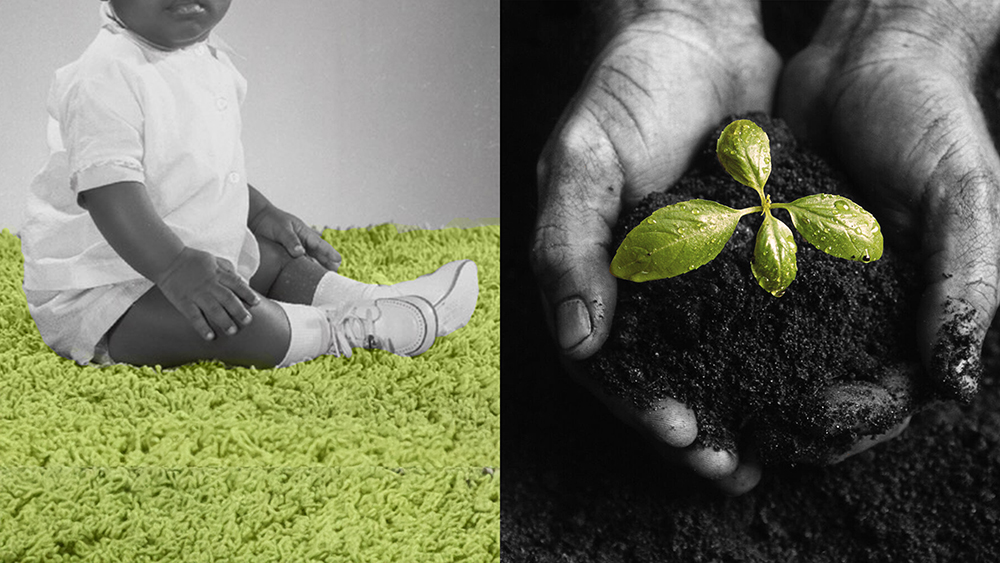
I don’t tell anyone that I’m envious of my son’s body. How it lives unscathed, unburdened, joyful, free. I must have been like this once, yet I have no memory of that version of myself. Perhaps, I’m angry instead of envious, full of rage for what has made me forget who I used to be.
To potty train a toddler one must be persistent yet patient. Firm, yet rewarding. This is what I learn from the parenting books. This is what I learn from the blogs. My son has been following us to the toilet for weeks. Curious about how we excavate ourselves, curious about what our bodies do and what this might mean for his body. It’s not until he protests his diaper changes that I look into potty training. All of the experts say we should follow our child’s lead.
I am living out what is called “gentle parenting,” a parenting style in which a child’s lead is something to follow. One in an entirely different universe from my own childhood. A childhood where there were rules that I learned to live by. To never talk back, to be seen and not heard, to be good by any means necessary. These rules were set by both of my parents, yet mostly enforced by my father. It was him who decided what happened if you broke the rules. It was him who decided the consequences. These consequences still live in my body.
I talk to my father for the first time in years. We’ve long been estranged. Our rare conversations exist in sporadic Facebook messages in which he sends birthday wishes and pictures of his side of the family. Our conversations are mostly one-sided monologues; he’ll always be my father; he can’t change the past. When I become a mother, the number of messages from my father increases. He’s found out he’s a grandfather through the usual distant family channels and now he wants something else from me — to meet his grandson.
There’s something I want too, yet the ‘something’ is hard to pin down. Is it an apology? Is it acknowledgement? An awareness of the ways that he’s parented me? A bearing of his sins? I want him to say it plainly: “I treated you horribly, and you deserved better.” Yes, maybe I want him to say it and mean it.
Gentle parenting, a term coined by Sarah Ockwell-Smith in 2016, focuses on parenting children through empathy, respect, understanding, and healthy boundaries. I learn about gentle parenting on Instagram through reels where moms talk through how they manage their toddler’s meltdowns and tantrums. In one video, I watch a Black mom gently hold her child as he writhes with frustration. He jerks his head back and hits her in the face, to which she responds by breathing slowly and repeating, “I know, I know… you’re so frustrated.” Soon, the child calms down.
The post, although not tagged with “gentle parenting,” carries the same tenets: empathy, respect, understanding. Gentle parenting counters “traditional parenting,” which focuses more on punishment and reward. Gentle parenting emphasizes managing emotions as a parent while teaching your child to do the same. It seems reasonable to me. Yet, each gentle parenting post is a town square where commenters argue about the “right” way to parent. The comment section is filled with opinions, from how gentle parenting is just “spoiling your child,” to “gentle parenting would never work for my child,” to “gentle parenting is just lazy parenting.” It’s through these comments that I learn there’s so much disdain for gentle parenting. Comments dismiss and reject these ideas. Commenters say it’s too soft of an approach. It makes me wonder what is so disturbing about this method. One that focuses on the child’s feelings, helps them regulate, and gives them an anchor to move through big emotions, while also providing the boundaries needed to create mutual trust and respect in the parent-child relationship. Why do we want to reject this so fervently?
“If we’re going to have any sort of relationship, we need to talk about what happened when I was younger,” I tell my father.
We are on the phone. My father wants to meet his grandson. I’m sitting at a table surrounded by empty chairs on the back porch of my home outside of Boston. It’s quiet and green here, so different from the apartment I used to share with my family. The small space with five people, sometimes six when my grandfather stayed with us. The apartment that felt even smaller and more suffocating whenever my father was home. Now, the empty chairs surround me, as if I’m the head of an invisible family.
“I don’t want to talk about that time in my life,” he says immediately.
I imagine him awkwardly shifting a cellphone against his cheek. He’s silent for a second. Before I can think of what to say he keeps going.
“Tati, I did a lot to get away from the past — I stopped drinking and using. That was a dark time in my life — I don’t want to talk about it.”
“It was difficult for me too,” I say. “There was a lot of abuse.”
“I never abused you!” His voice is loud and indignant.
It’s been a while since I’ve heard this voice, yet during my childhood I knew it better than my own. I knew its tone and tenor, that when I heard it, it meant best to steer clear.
Even though I am an adult, listening to his voice at this moment makes my stomach drop. My mind searches for the memories I know still exist. Why do I keep remembering what he says he never did?
“That’s not what I remember,” I manage to say. My stomach churns as my anxiety rises.
“I never abused you,” he says again and again.
“You spanked us, right? Did you know — that’s abuse?” I’m surprised at my own voice, able to speak these words directly to him.
Saying the word “spanked” feels strange. It wasn’t just spanking, or small hits every now and again. There were raised welts on the skin. Questions from teachers at school. Bruises. Hangers. More. Yet he keeps repeating it. An incantation. “I never abused you. I never abused you.”
“What about that time after the grocery store? You couldn’t find me and you were upset and when we got home you beat me because of it.”
“Remember I took you to the park and to baseball games? Why don’t you remember all of the good things I did?”
Why don’t I remember all the good things he did? What were the good things he did?
“I’m just telling you what I remember,” I say.
“I’m not an abuser. What about your mother? What about all the things she did?” He’s yelling now. Talking over me. Rambling. I’m quiet.
“I mean… I only hit you once, and it’s when you were really little. You didn’t tell me you had to go to the bathroom. You just looked at me and peed on yourself. I hit you because you peed on yourself.”
At my son’s daycare the teachers are just as committed to helping our toddler potty train as us.
“We don’t ever want them to feel embarrassed or upset if they have an accident,” the lead teacher says.
I nod my head. “Of course not.”
“We just keep reminding them and he’ll get it soon,” the teacher says.
Each day at daycare, we get a green plastic bag with our toddler’s wet clothes. His jeans, his Spiderman underwear, his sweatpants. All evidence that he’s still learning. We say all the things we believe are right.
Did you potty today?
Did you tell your teacher you had to potty?
You’re doing so great with the potty.
The potty becomes our life. We can’t stop thinking of the potty and when he’s last gone. We jump and say, “Potty time! Let’s pause what we’re doing.” We coax and cajole him to follow us.
“No potty right now,” he says over and over.
“Let’s try,” we say.
We get into stand offs. We try to keep it low key. We throw away all the diapers. We keep moving forward.
We read our son Pottysaurus and I’m a Potty Super Hero while he sits on the potty. “I’m so proud of you,” my husband says when our son makes it in time. We both say it so much that our son now runs around after the potty yelling, “I’m so proud of you!”
Despite the Instagram posts I see about not saying “good job” or “I’m proud of you” I still do it. How else can I learn if I’m parenting right, if not for a series of experts in 30-second online videos touting the best way to do so? Yet these posts often make me feel inept in my parenting. Good job. I’m so proud of you. I can’t stop myself. Perhaps it’s because I’m saying what I most wanted to hear as a child.
I don’t know what to say to my father about his story of me peeing on myself. I don’t remember the incident, but it feels true. It feels possible. I have vague memories of my own potty training. I remember the potty being in the living room at my grandmother’s house. I remember sitting on it and wanting to get up. I remember an uncle teasing me, singing, “Tati Goes to the Potty” over and over again. I remember crying about it, but I don’t remember looking him in the eye and then peeing on myself. I don’t remember why I did what he says I did. I don’t think he understands that for my young toddler self, there was no why. I was still learning.
I struggle to hold the distance between my father’s approaches to parenting and mine. Although he may not have realized it, my father was an “authoritarian parent.” A parent who relied heavily on discipline, who always expected goodness and obedience, who blurred the lines between discipline and abuse so much that they were one in the same. This is how I believed all children were parented. I didn’t know that this was called a “parenting style,” a phrase developed in the 1960s1 when my father was just a child. He was a child who was also beaten, not solely because he was being disciplined, but for the widely accepted belief that this is how children should be raised.
Dr. Stacey Patton discusses this in Spare the Kids: Why Whupping Children Won’t Save Black America, noting that “hitting and abusing children has a long history that’s been part of virtually every culture and society dating back to biblical times.”2 Although her book refers to the Black American experience of corporal punishment for children, she begins with the often-overlooked fact that this type of abuse has been a reality for children of all races, all classes, all backgrounds for centuries. What she describes is what I often felt true in my own childhood. That being a child, regardless of where you come from, means you don’t have any control of anything — that you’re at the whim of those around you; and that in itself puts you at risk of violence. What would this mean for me now raising a child? Would my son, too, be at risk of an inherent violence?
It’s bedtime and our son is running around naked and giggling. He doesn’t want to take a bath. He wants to hide and for us to find him. We try to make it sound fun.
“Look at all the toys in the tub waiting for you!”
“There are so many bubbles in there”
“Don’t you want to play with Mr. Whale?”
He doesn’t care about the toy whale, or the bubbles, or anything but running around. He just keeps running. Finally, he hops onto his bed and lays down, his naked body rolling in the blankets. And then I notice the sheets getting wet. He’s quietly peeing all over his bed.
“Stop!” I yell. I yank him up and run him over to the potty in the bathroom.
“Why did you do that?” I demand. I’m tired and the warmth has left my voice.
“I JUST changed the sheets!” I say to my husband. He sighs.
I’m furious, but in looking at my son’s nonchalant face I know he doesn’t care. How could he? He’s not really supposed to. He’s still learning. Yet, the anger wells within me. I leave the bathroom.
“Can you handle this?” I ask my husband. He steps in and finishes with our son at the potty. I go back to his bedroom and yank the sheets off the bed. I’m so angry.
Is this the moment where it could happen? I think to myself. Is there a moment, like the one my father had, where you can get so angry that you hit your child?
When I was pregnant, my husband and I watched this reality show on ABC about parenting called “The Parent Test.” It gathered different families with different parenting styles. There was the “disciplined parent,” the “negotiating parent,” “the helicopter parent.” Through challenges with these parents’ actual children, they’d decide which type of parent was the most effective. In one particular episode, I remember being stunned when more than half of the parents raised their hands to say that they physically disciplined their children. And in this reveal, it was positioned as a personal choice, a parenting style, like gentle parenting. A viable option for how to raise children.
Physical discipline of children, or “spanking,” or the more all-encompassing term “corporal punishment,” is known to lead to many behavioral, mental and physical problems throughout life.3 During childhood, children who live with corporal punishment can experience anxiety, depression, and behavioral problems.4 Even more, children who experience physical discipline have a higher prevalence of inflicting violence on others.5
What did my father know of the intricacies of child development? Of the mental well-being of children? Of the connectedness of his own violence begetting a future violence after his children grew up?
It takes me having to be away from my toddler for a little while for me to cool off after Bed-Wetting Gate. When he’s done with his bath, he says, “I peed on the bed,” in his haltingly sweet toddler voice. I look at him and just laugh. What could be going on in that little brain? Was this one of those hallmark toddler moments of following an intrusive thought and seeing what happens?
I pick him up and look at him. “Pee pee only goes in the potty, ok?”
He repeats it back to me: “Pee pee only goes in the potty.”
One of my younger brothers used to pee the bed so often our room smelled like it.
“He peed the bed again,” I’d complain to my mom.
He’d get in trouble, but I didn’t care. I didn’t care that he was punished. It seemed like he peed himself all the time. At school, at night. While playing. It was endless and I just didn’t understand why he couldn’t just use the bathroom. I guess I still thought so until recently, when my sister reminded me of the time my brother played baseball and kept making mistakes and how our father kept yelling at him. And right there in the field he peed himself.
“I can’t stop thinking about it,” my sister said.
“I didn’t remember that,” I said guiltily. Why didn’t I remember that?
It isn’t until I’m older that I realize that, outside of potty training, children can pee on themselves sometimes because they are anxious. Or grieving. Or stressed.6 It’s often outside of their control and I hate my own naiveness about the reality of my brother’s life.
When my father tells me about the time I wet myself, I don’t bring up what I’ve learned over the years about trauma or childhood abuse. I don’t bring up gentle parenting and the endless videos I’ve saved about it. I realize we don’t speak the same language. I just listen to him.
“I mean, your grandmother did it to us…” My father says.
“Oh,” I say.
It’s a family legacy, I think to myself.
I want to say something but he is so certain he did his best. So certain that his way of parenting was never that bad. So certain that what was passed down to me and my siblings is really just what was passed down to him. It’s when he mentions my grandmother that I decide that he can never meet his grandson: I know then that with all this time, within all his changes, he is still trapped in his own rituals of parenting. He is still reeling from his own relationship to punishment, to his own relationship to his own childhood.
There’s anecdotal evidence that suggests that gentle parenting can actually put more pressure on parents, leading to more stress.7 Yet, there’s also anecdotal evidence that notes that a gentle parenting style can support emotional regulation in children and in parents. Gentle parenting can be healing, gentle parenting can be difficult, gentle parenting can be an opportunity. An opportunity to reparent the self while parenting the child.8 An opportunity to instill mutual safety. And if this is true, what would this mean of my father’s parenting style? Perhaps his authoritarian parenting style allowed for the opportunity to exert power over someone else in the way it was exerted over him. Perhaps the act of physically punishing a child is a way one enacts the same violence they were once subject to.
The daycare teachers were right. One day, it just clicks and my son can use the potty. He’s excited. When he’s finished, he runs up to the nearest person and yells “I used the potty!” — even strangers in public restrooms. The act of potty-ing forms a routine in his memory. It becomes secondhand, natural, and organic. This is development. This is learning. This is how the brain and body remember.
“I’m a potty superhero!” our son exclaims. He does this often, especially when he’s made it to the potty. Our toddler still has the occasional accident. And when he does, we let him choose the underwear he wants to wear. We make the accident an opportunity to look forward to something. We tell him he’s still learning. And he is. We keep trying and he keeps trying. And each time he exclaims in joy, “I went to the potty.” He’s excited to have learned something new. “I’m so proud of you” he says to himself. He repeats it to me. He repeats it to his father. “I’m so proud of you! I’m so proud of you!” I want to believe he knows what he’s saying. That he is proud of us. That we are the parents he needs. That we are doing the right thing, even when we make mistakes. That we have survived all the harm that lives in us. That we have been gentle enough with our own selves that our bodies have found a way to offer a safety that we used to yearn for. That in the joy of his freedom we remember our own — what was innately given, what even among injury, can never be taken away.
1 “Parenting Styles.” Psychology Today, Sussex Publishers, http://www.psychologytoday.com/us/basics/parenting/parenting-styles. Accessed 22 Dec. 2025.
2 Patton, Stacey. Spare the Kids : Why Whupping Children Won’t Save Black America. Boston, Beacon Press, 2017, p. 32.
3 Gershoff, Elizabeth T, and Andrew Grogan-Kaylor. “Spanking and Child Outcomes: Old Controversies and New Meta-Analyses.” Journal of Family Psychology : JFP : Journal of the Division of Family Psychology of the American Psychological Association (Division 43), U.S. National Library of Medicine, June 2016, pmc.ncbi.nlm.nih.gov/articles/PMC7992110/.
4 “Authoritarian Parenting: Its Impact, Causes, and Indications.” Psychology Today, Sussex Publishers, www.psychologytoday.com/us/blog/overcoming-destructive-anger/202402/authoritarian-parenting-its-impact-causes-and-indications. Accessed 22 Dec. 2025.
5 https://www.who.int/news-room/fact-sheets/detail/corporal-punishment-and-health
6 Urinary Incontinence in Children | Johns Hopkins Medicine, https://www.hopkinsmedicine.org/health/conditions-and-diseases/urinary-incontinence/urinary-incontinence-in-children. Accessed 22 Dec. 2025.
7 Edlynn, Emily. “What’s Wrong with Gentle Parenting? | Psychology Today.” www.psychologytoday.com, 18 Mar. 2024, http://www.psychologytoday.com/us/blog/parenting-is-not-a-fad/202403/whats-wrong-with-gentle-parenting.
8 Tenety, Elizabeth, and Elizabeth Tenety. “How Gentle Parenting Can Heal Your Inner Child and Shape Kids.” Motherly, 6 Feb. 2025, http://www.mother.ly/news/viral-tiktok-video-on-gentle-parenting/.