Editor’s Note
When I dreamed up this anthology, I was wrapped in my own overlapping separations and looking out at a world that felt increasingly distant from its own humanity. From birth- and chosen-family reintegration to disentangling myself from state-sanctioned value and survival systems, I was experiencing a fragmentary version of the violent separations enacted upon diverse communities over countless lifetimes.
This was how, as the start of 2025 unfolded around large-scale distortions of power spawning protests even in the town I called home at the time, I found myself watching the birds. Specifically a pair who built a nest in the crook of the porch and hatched a handful of tiny chicks. Those chicks grew and grew, screeching all the while, until one day they were all simply gone — parents and chicks and piercing screeches alike. The abruptness of this transition — the chicks’ movement from baby to adult, their precise and permanent separation from the nest — disoriented me. Why did they leave? Perhaps because it was the only way they could carry on living.
Who else lives here? I wondered. Who else exists in the now because of a necessary or dreaded or beloved moment of separation?
We meet On Separation’s contributors at a multitude of origins. Some narratives sprang from the experience of separation as distance. Others emerged from how separation brought them closer to both self and other.
The writers’ stories stretch across continents and root themselves within the most intimate moments of severance.
They invite reflection and challenge common narratives. They imbue pain with tenderness and let their grief sound loud. They name the unspoken with lyricism that lingers and precision that invites tears.
I transformed alongside these writers and their work as the summer bowed to fall. My own experience of separation grew in both welcome and uncomfortable ways, and I found myself seeking solstice in their words. I was reminded with each reread that while Merriam-Webster defines separation as the act or state of being kept apart or dispersed, another equally true definition might be the act of transitioning from one experience to another, of deconstructing and recommitting to bodies and ways of being, perhaps in service of clearing the way for the totality of our future lives.
Table of Contents
What’s inside “On Separation”? Editor-in-Chief Naomi Day describes each piece that is in their anthology.
Mia Nakaji Monnier’s poems begin and end with her relationship with her daughter. In these sparse and poignant meditations on “living as a relay” between parent and child, Mia unfolds visions of separation as a requisite pathway towards lifelong connection.
Katelyn Durst Rivas’s poems delve into the communal severing that lurks at the origin of her adopteehood. Across a multitude of motherhoods, Katelyn consciously seeks a “resolution where there is none” within multiple timelines of mother-daughter-hood.
Kimberly Henri-Amor’s watercolor poems illuminate the deep grief and grace of an unexpected journey of sundering. Guided by her Indigenous ancestors, Kim translates her redirection of spirit through a sweeping narration illustrated by watercolors of her journey into and through self.
Yuqi Li’s poetic photo-essay narrates their journeys across oceans both literal and lineal. Traveling along memories and geography, Yuqi burrows into language to understand what a journey of homing means to one raised in migration.
Eve Xin’s poems live in “the aftermath, the ruins, the ghosts” that haunt the long tail of separation. With viscerally tender specificity, Eve addresses the self, past and present, and offers a heart-forward bravery to accompany them into their future lives.
Christa Lei’s essay braids a nuanced moment of relational transition with a meandering exploration through patience, hope, and grief. With an eye always turned towards the monumental, Christa trawls through their patterns in search of a guide to weathering the storms of enduring love.
Mahogany Nored’s poem collapses the distance between then and now to reckon with their sense that “in this world, we’re not meant to last all that long.” Moving adeptly between dissociation and connection, Mahogany probes the intimacies and identities living across their separated selves in search of unification in the beyond.
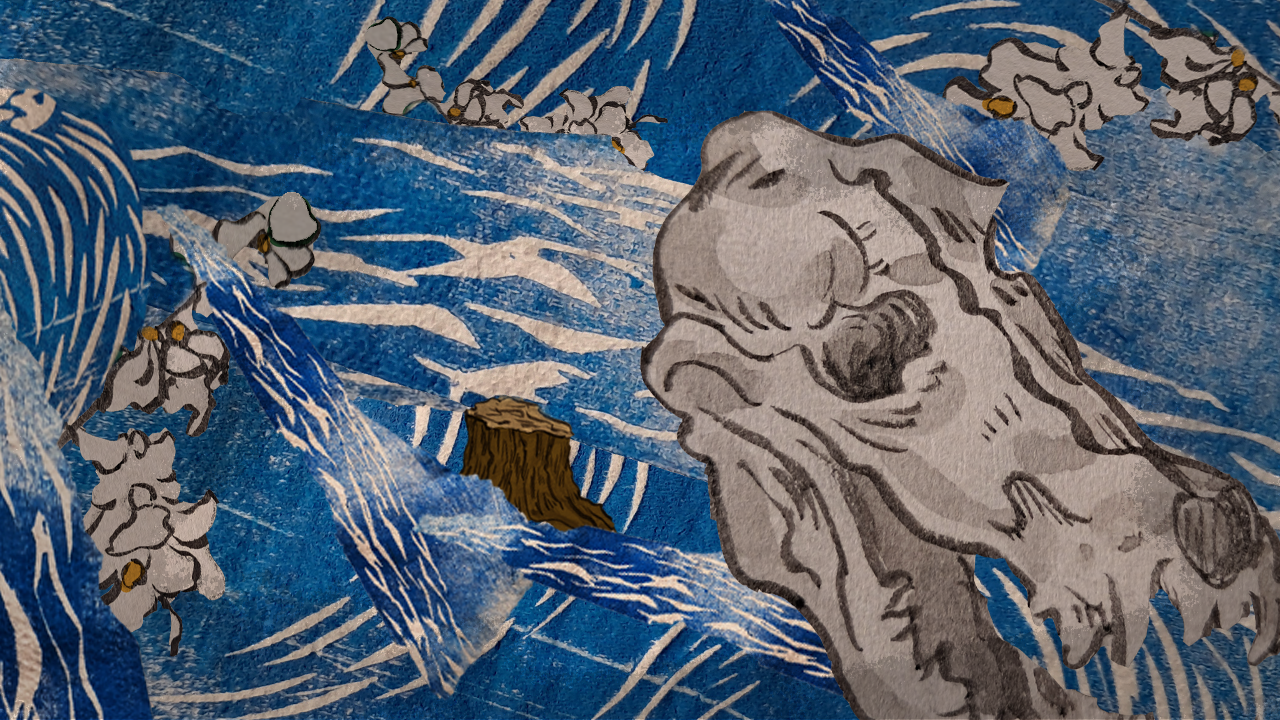
Kiara Gilbert’s artwork layers gorgeously rendered mixed media collages with the contributors’ desires to “disrupt narratives made salient by the passage of time.” Via watery palettes that evoke both continuity and loss, Kiara explores the distance and proximity of varied desires for closeness.
Close"On Separation" original call for submissions
This is the call for submissions, which is what the published contributors submitted work toward:
Separation — detachment, uncoupling, sundering — is a foundational human experience. We begin life by discovering ourselves as separate from those who birthed us. We depart from and renegotiate boundaries with loved ones as we grow older, and we learn to release belief systems in order to invite in new ones. We engage in consistent and ongoing rhythms of recalibration across both our heaviest and most joyous times.
This anthology invites musings on separation as both an act of love and an essential path to nurturing our new worlds. The topic is grounded in my experience of separation as both hurt and hope, and my curiosity towards the deep kindness seeded within that spectrum. What is the breaking and the building that takes place within individual and communal severing? If we take transformations within interpersonal relationships as impetus for radical change on a larger scale, what systems can we separate from and redefine our relationships with? When we dismantle bridges we no longer wish to cross, what pathways emerge for future reconnection? Separation invokes grief, but it also invites brightness — the gleam of a life perhaps never anticipated, but on its way regardless.
This anthology is open to submissions from BIPOC writers and artists, and I’m particularly interested in work from Black and queer creatives. I’m eager for words that stretch across genre and medium in forms such as speculative narratives, photo essays, and hybrid creations. I invite all work that uniquely engages with visions of hope, meditations on transformation, and the persistence of separation.
Close