About Poetry in Praxis: Poets are often asked to justify the politics of their art, as though politics were a motif, a theme, or a metaphor, and not the material of their lives. Instead, we might ask, how does poetry shape our political worlds, our movement workers, our radical imaginations? This series, “Poetry in Praxis,” rejects the division of art and politics by hearing from leaders on the frontlines of political struggle about how poetry becomes practice, and vice versa. Each installment offers a conversation with an organizer about the poetry they not only love but need, asking: What does the poem teach you about political struggle? How does poetry complement, expand, or contradict your work as an organizer? What might organizers adopt from the forms or methods of poetry? This series brings together political and community organizers from across movements to answer the question of what poetry can do off the page, and how it just might be an essential part of our movements for liberation.
On an average day, Vicky A. trains volunteers on how to shut down a gas plant. In the morning she plays piano and reads, walks her dogs, and hops on the video call. Lately, she’s been organizing for State legislation to address the plastic waste crisis, but she’s also blockaded fossil fuel sites, protested fracking on public lands, and defeated plastic incineration facilities. She’s driven into the rural towns of her Midwestern state where petrochemical corporations hope to inconspicuously develop facilities in poor, abandoned counties, and she’s developed communities’ ability to fight back. Her home is alive with friends and visitors, organizing meetings and karaoke parties. In her yard, she tends to the compost and picks wild berries.
The following interview has been edited for length and clarity. You can listen to the audio of the interview in full below.
Isaiah Back-Gaal: Thanks for being here, Vicky. I’m so happy to get a chat with you about poetry and political struggle.
Vicky A.: Thanks for having me. I’m excited to be here.
Isaiah: I’d love to start by talking about who you are. Could you tell us a bit about your work and your political organizing?
Vicky: Yeah, I can. My name is Vicky. I am based in the Midwestern United States and I am a community organizer first, very interested and practiced in community based organizing, and also active in environmental organizing and advocacy. That’s what I do professionally — part of the way that I make money to support myself — I do environmental advocacy work. I’ve been organizing for like eight years now. I definitely think that I still have so much to learn and I find new mentors in the space all the time. But I’m kind of at a stage where I’m like, yeah, I’m an organizer. I’ve been organizing. I work lately on plastic reduction and waste crisis issues and have spanned a lot of different issue areas, from electoral to social and racial justice. But I found my home, I would say, in environmental community organizing.
Isaiah: Could you say a little bit about what brought you to organizing?
Vicky: I kind of stumbled into it without really looking for it. That is to say, it found me. I had moved to go to grad school and had been really interested in climate crisis. I had been studying climate change and what it means in college and I was interested in getting more involved. I initially thought [getting involved] was going to happen for me in graduate school. But instead, what happened was I discovered that what I would rather be doing instead of studying an issue is actually actively participating in the ongoing struggle. I have always been really connected with the natural world and I grew up in a national park area. I was always outside as a kid. I used that a lot growing up as a place to find safety and comfort when things were hard. Leaning into that more led itself to organizing and advocacy. So I think that’s what got me started, this deep connection that I felt to the issue and connecting it to myself and my lived experience, growing up in that area, but also being a young, second generation person who was in a very rural and conservative area that was mostly white and I was brown. And learning about how all of that impacted me really led me into [organizing]. That keeps me in it for the long haul.
Isaiah: You alluded to the fact that we’ve known each other for a bit. And I love the way that you put it, that you feel like you’ve been in this for so long and are also always new, which I really relate to. When I think of you, I think of someone whose political work intersects and blends with other aspects of your life. From the way that you foster your relationships and tend to your home, move around the city and interact with strangers. I’m wondering if you could describe the community that you’ve built? If you could paint us a picture of some of the crises that you see or the structures of resilience that you’ve built?
Vicky: I have ended up in this role as a connector in my community, a facilitator of the types of spaces that are required to build things that last. I’ve been trying to accept that a little more because I do think that the things that matter to me a lot are characteristic of a person who is connecting people. I feel like I’m naturally drawn to it. I didn’t always realize how much work it takes. For example, building spaces where people regularly come together to connect and perform acts of care for each other that are not tied to anything we’re organizing around. It might just be that we get together for a group dinner, a meal, or maybe we’re connecting just to share a grounding space or read together, write together, do all of that stuff. I have ended up in those places because I know that’s what I need to feel like I can move through this world and survive this world as the person that I am. In a way, it’s really self serving, but also it’s about that genuine desire for community. I feel like I’ve been trying to build spaces that otherwise don’t exist — I’ve been trying to host community gatherings centered around art or centered around meals. Growing up, meal time was such a huge point of connection in my family and continues to be. That’s really just how I was socialized to create memories.
I feel like I follow the energy of the community when I’m pouring into creating spaces like that. That makes it very non linear and hard to keep track of, but so rewarding. I feel like it literally changes my brain chemistry every day to be oriented towards those things.
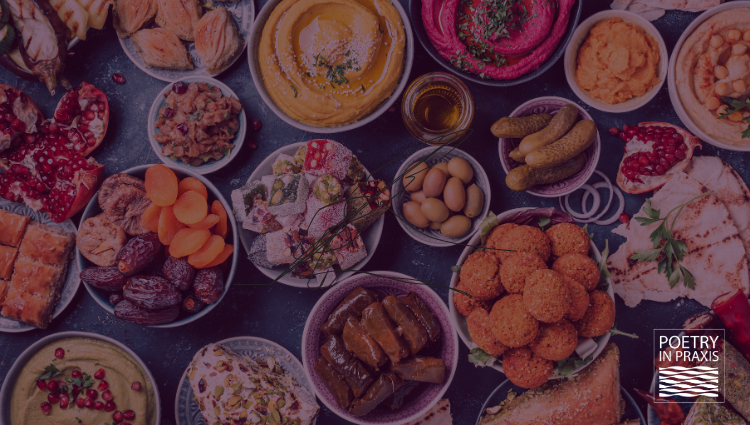
A while ago I was trying to organize a community dinner series that was focused on recognizing the abundance that we can access together without having to put forth so much effort. A potluck, but with ingredients, and then emphasizing cooking a meal together, setting a table together, eating together, sharing stories together, those kinds of community spaces and also spaces to share art and celebrate artists in our communities. Some friends and I organized an art gallery that was a benefit for organizations focused on Palestinian liberation. We wanted to focus on artists who are of Palestinian descent or Middle Eastern North African descent and were located locally. We had a really beautiful event. We shared tea, we shared sweets. Everyone’s families were invited to come. We received a grant to do this work and got to distribute all of that money to the community and then fundraise for relief efforts. And it was all centered around the creation of art for liberatory purposes. That was really beautiful.
From there, a lot of the artists got to become friends when they hadn’t known each other before, which has been so amazing to be part of. Some of us now are even involved in a second generation Arabic language learning group that I see as rooted in that event. We meet every other week and we focus on building community together through re — not reclaiming, or relearning, because none of us are fluent — I guess reminding ourselves of the language that we aspire to be able to speak fluently because it is part of our cultural backgrounds. I feel like I follow the energy of the community when I’m pouring into creating spaces like that. That makes it very non linear and hard to keep track of, but so rewarding. I feel like it literally changes my brain chemistry every day to be oriented towards those things.
Isaiah: You mentioned art as a liberatory practice, which is a perfect segue to talk about poetry. I asked you to bring a poem today, and you brought the poem, “A Litany for Survival” by Audre Lorde. Would you read the poem?
Vicky: It was so hard to pick one poem. It took forever for me to pick.
For those of us who live at the shoreline
standing upon the constant edges of decision
crucial and alone
for those of us who cannot indulge
the passing dreams of choice
who love in doorways coming and going
in the hours between dawns
looking inward and outward
at once before and after
seeking a now that can breed
futures
like bread in our children’s mouths
so their dreams will not reflect
the death of ours;
For those of us
who were imprinted with fear
like a faint line in the center of our foreheads
learning to be afraid with our mother’s milk
for by this weapon
this illusion of some safety to be found
the heavy-footed hoped to silence us
For all of us
this instant and this triumph
We were never meant to survive.
And when the sun rises we are afraid
it might not remain
when the sun sets we are afraid
it might not rise in the morning
when our stomachs are full we are afraid
of indigestion
when our stomachs are empty we are afraid
we may never eat again
when we are loved we are afraid
love will vanish
when we are alone we are afraid
love will never return
and when we speak we are afraid
our words will not be heard
nor welcomed
but when we are silent
we are still afraid
So it is better to speak
remembering
we were never meant to survive.
— Audre Lorde
Isaiah: So why this poem?
Vicky: Audre Lorde is such an iconic example of someone who puts poetry into practice. Becoming more familiar with her work over the years, reading her prose, essays and poems, I’ve been doing that alongside my own development as a political being. I wanted to pick a poem that I’ve known for a while. I wanted to pick something that I haven’t returned to in a little bit and see how I feel about it now. You know when you read something the first time and it just really strikes you, and then you read it again and you get something different out of it every time? So when I was going through my personal collection, I was reminded of this poem as one that still rings true for me and also one that reminds me of other poems and poets that I’ve been getting to know since I first read this poem.
The themes are so present: we have to speak and we have to live, because the forces and the powers that be are betting on us giving up, abandoning our lived practices, feeling too weak or powerless. So that’s why I came back to that poem. It reminds me of the need to be unafraid to speak because they’re coming for us either way. And it reminds me of something that my dad always told me when I was a kid. Whenever I would be scared of anything, he would always tell me, you cannot let fear dictate how you live your life. You have to live. I’ve always held that. Growing up with him and growing up myself, I feel like I can see where he gets that from. Being Lebanese and being so connected to the region, you must live is such a standard turn of phrase. It is because of necessity. I’ve been thinking about that a lot lately, especially with everything that’s going on. So this poem still really means a lot to me after many years. I still find a lot of myself in it. It felt like a natural choice. Even though I was having trouble deciding, I was like, it’s going to be that poem at the end of the day.
The themes are so present: we have to speak and we have to live, because the forces and the powers that be are betting on us giving up, abandoning our lived practices, feeling too weak or powerless.
Isaiah: Poetry is such a condensed form of language, it’s asking us to give all of our attention to the use of language. But we use language in really particular ways in political organizing. We write op-eds, speeches, slogans, and chants. We use particular language when we’re facilitating a meeting and we want to instill a feeling of hope or inspiration. We think really strategically about our words. I’m wondering how our political language compares with the language of poetry, or perhaps with this poem in particular?
Vicky: That’s such a part of the art of organizing that can be overlooked, and I think it is such a huge component of training. Something I do a lot now is training people how to organize. Language is so important because whether or not you realize it, if you are someone who is starting a conversation, you’re going to be viewed as the person who has the answers. Language can give power to people who feel like they’re so new in a space and they don’t know what they’re doing. I feel like it takes people so far, and that’s one of my favorite parts about leadership development for organizers.
In this poem, something that really carries me is futurism. That’s definitely part of what we do as organizers. When I was a very young new organizer, a mentor in the space once told me, organizers are the creatives of our future realities. They’re the ones who are painting the picture of what the future could look like. Poets are doing that, too. I think it overlaps so much. We write poetry for so many reasons. I know I turn to it when I am feeling like I need to comprehend my feelings about social and political issues. It’s such a powerful tool to understand that for yourself and in a community. I get that a lot from this poem. “Seeking a now that can breed futures like bread in our children’s mouths, so their dreams will not reflect the death of ours.” You wouldn’t say exactly that in an organizing meeting, but you might say something pretty similar to that. “We were never meant to survive.” I’ve heard so many people speak in those terms. It’s so impactful to be able to say so much in a poem like this. We could go line by line, forever in this poem. These lines really remind me of that connection between organizing and poetry.
Isaiah: One of the things that stuck out to me in this poem is the repetition of the words “for those of us.” Lorde says that again and again. I don’t think the word “I” is in the poem at all. It’s all in the first person plural, the “we” perspective. In the first three lines she says, “for those of us who live at the shoreline / standing upon the constant edges of decision / crucial and alone.” Lorde names a feeling of aloneness, a feeling of tenuousness. So there’s this aloneness, but at the same time, it’s all in this “we” voice, and so in some ways, inherently, there’s a sense of togetherness. She’s speaking to other people that might feel a similar way or be from a similar place. I wonder how that relates to the work of political organizing, and the way that organizing contends with both the individual person as well as the collective?
Vicky: I think that is why people start organizing. As organizers, when you’re doing outreach, you’re keeping your eyes open for people who are at this point where they’re needing some form of community, some form of “us” or “we,” and coming from a place of feeling alone maybe. That’s such a huge turning point. I think poetry is such a beautiful mechanism for being able to identify that self interest. Something that we’ve done locally a couple times is shared writing spaces where we’re taking time to journal or write an essay. We work a lot on op-eds, letters to the editor, and that’s great, but it’s also about writing what this means to us and creating that sense of “us.” I think that’s a beautiful, beautiful thing about doing organizing work at the community level: being able to create that sense of, you know, this isn’t just happening to me, it’s happening to all of us. Being able to interpret the world from that standpoint. Some of the most impactful work for me in organizing, especially with youth organizers and climate justice spaces or environmental justice spaces, is those moments where we’ve created things like poetry, prose, or recipes together, put them together, distributed them in zines and made art and collages and all this stuff to get at that feeling. We may be feeling powerless and at times alone, but this is a litany for survival. This is us seeking a now that can breed futures, knowing that we are afraid, but we are still going to take action despite those feelings and those fears.
Isaiah: Is there anything else that you think we as organizers could take from this poem? Anything that it might teach us about struggle or about strategy?
Vicky: In this political moment, it’s the last half of the poem that strikes me as incredibly informative. What we can learn is what we could relearn. We’re going to be put to the test as a movement. We are going to be afraid, and we’re subject to so much political language that is leading us to retreat into that fear. It’s not for nothing. Things are so incredibly scary right now. But it’s a reminder that it’s still going to be scary. And we have to remember to still speak. I think that’s really the baseline. I’ve noticed especially in the professionalization of organizing in some ways, this inclination to take a step back when things are getting a bit more hot. It’s a really hard line to walk sometimes, because we are at risk, those of us who live at the shoreline, standing upon the constant edges of decision. There’s a lot of marginalization that contributes to our feelings of fear. But that remembrance of needing to speak…
I also think it makes me think: organizers should be writing poetry. You don’t have to be shouting from the rooftops to everyone all the time about, like, sign my whatever, take up my issue, come to our rally. Organizers should be writing poetry. It’s such an emotional guidance for action. It’s grounding, it’s clarifying, it’s centering. And it gives us so much life when a lot of organizing itself is so exhausting. I’ve been thinking about this a lot lately, all of the ways that poetry takes shape, especially, poetry in motion, like music and dance and what happens when those things are married together and how much freedom is found in those types of interactions. Feeling that power that comes from the creative outlets that poetry provides us. That comes to me, too, a lot from this poem.
We may be feeling powerless and at times alone, but this is a litany for survival. This is us seeking a now that can breed futures, knowing that we are afraid, but we are still going to take action despite those feelings and those fears.
Isaiah: Are there any political or creative projects that you want to shout out?
Vicky: I did want to shout out a poet, a Filipina poet named Barbara Jane Reyes. If you’ve never heard of her and you identify with the Filipino American or Asian American immigrant experience, her poetry is so fruitful to turn towards. One of the poems I was going between for this interview is her poem, “Brown Girl Fields Many Questions.” The first time I read that poem, I was like, sobbing. I’ll also just say that wherever you are, do some actual dedicated research into what is coming from the ground relating to political projects near you, because those are going to be the most impactful ones in your life.
“A Litany for Survival.” Copyright © 1978 by Audre Lorde, from THE COLLECTED POEMS OF AUDRE LORDE by Audre Lorde. Used by permission of W. W. Norton & Company, Inc.