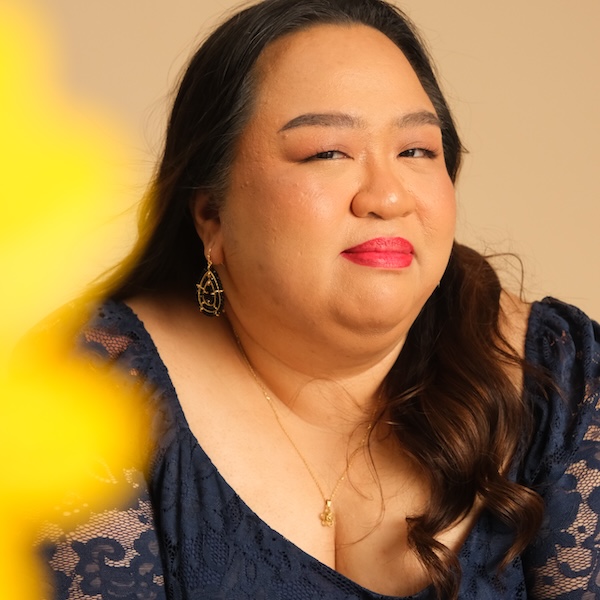

Editorial Note: T. De Los Reyes was a finalist for our Editors-in-Chief position for our 2026 Community Anthologies. We invited our finalists to write a short piece on the topic of their proposed anthology. Below, get insight into “On Mother Tongues,” the anthology topic that T. had proposed for their Community Anthology.
I first heard that Tagalog came from “taga-ilog,” meaning “people from the river,” from one of my elders. I no longer remember exactly where we were when they told me, but I can still feel the satisfaction of the word opening itself to me: “taga,” meaning “from,” and “ilog” meaning “river.” For years afterwards, I carried this as a family story, whether or not language scholars would agree with it. It made my mother tongue feel more like a place I could make a home in. There was a river inside its name, a whole geography compressed into a single word.
When Spain colonized the Philippines for more than three centuries, they asked us to discard our names. Then America bought us and stayed in our country for fifty years. Each replaced the language of the last with their own. When Japan occupied us during the Second World War, it banned English from our classrooms for four years. My mother tongue remained where it had always been, at the bottom of every curriculum, under every flag.
When we fought back for our independence, English remained the language of ambition and Tagalog became the language of home. The regional languages were pushed further still: Cebuano, Kapampangan, Hiligaynon, Ilocano, Bisaya, among others. The farther you moved from Manila, the further you moved from the center of power.
I have been thinking about what it means to speak a language that has already been taken from you more than once. My own relationship to Tagalog is a compromise, as I write most of my poems in English. I dream, sometimes, in a mixture of both, but when I reach for the exact word, the one that will carry everything I mean, I sometimes find only English waiting, patient and wrong.
There are things English cannot hold. In Tagalog, “tála” means star. But “talâ” also means writing, something recorded and kept. “Tula,” meanwhile, is a poem. It stands at the point where star and writing meet, although I know the resemblance between words does not necessarily prove a shared origin. Still, that is how the words live in my ear. And so when English translates these, it separates what Tagalog held together. Star becomes one thing while writing becomes another. Either way, the poem loses its address.
When I say that an untranslatable word is a temporal object, I mean that it arrives from somewhere, whether it’s from my grandmother’s mouth or from a way of being in the world. And while it exists in the present, it is also often under pressure and endangered. What then of a future that hasn’t happened yet, that is, a world that would need to exist for that word to be fully speakable? When I speak my mother tongue, I am briefly in several times at once.
Gloria Anzaldúa wrote that to attack a language is to attack the people who speak it, that ethnic and linguistic identities cannot be separated. The tongue is a site where meaning lives, where belonging is made and unmade. To have your language taken is to lose the particular way the world existed before the taking.
That being said, the colonial interruption of the mother tongue is a global condition. I think of writers and artists who come from different backgrounds: a poet from Nigeria whose name spans two countries, a Bengali raised in Italy before moving to America, a Chicana navigating the language of childhood versus adulthood, a critic in New York who continues to imagine in Persian, a Korean who grew up in Hawai’i, a Cebuano working with a dialect pushed to the margins.
The questions I keep returning to: What do I reach for when English fails me? What must we do with a collection of untranslatabilities? How do we place them in conversation so that the gaps between them become visible?
The mother tongue is not a relic. What would it mean to speak a word into a future finally large enough to hold it? Who inherits the words we could not keep? What is the future tense of a tongue that has been interrupted, and how do you conjugate a return?