TO ARTS AND CULTURAL INSTITUTIONS, CEOS, DIRECTORS, BOARDS OF DIRECTORS, CURATORS, DONORS, COLLECTORS, PUBLISHERS, EDITORS, AND OTHER ARTISTS (ARTS AND CULTURE LOYALTY BOARD):
I, __________[NAME]___________, BEING FIRST DULY SWORN, DEPOSE AND SAY AS FOLLOWS:
A) I believe that art has innate transformational power.
B) I believe the very practice of art pushes against society’s norms. Art challenges the known limits of emotional and aesthetic experiences.
C) Unfortunately, our contemporary society is being destroyed by division and polarization. Opposing sides reach answers before questions are even asked. Conversations where all perspectives are genuinely considered are rare, if they can even be had.
D) I believe that, in this fraught moment, the most urgent and needed artworks are those that can bring us together. Artworks that reach across boundaries, helping us to see in many different ways, through many different eyes.
E) I promise to create artworks that are small acts of resistance against the forces that divide us. To fulfill this, I must remain open to the myriad complexities of all human experience.
F) Inherent to this experience are contradictions and multiplicities. I promise to uphold the artist’s unique role of fully and freely expressing these, without need for resolution. Other vocations do not have this privilege and I will protect it fiercely.
G) I will acknowledge the problems that plague contemporary society—ie. wars, the degradation of the natural world, loss of cultural diversity, migratory and diasporic experiences—but I promise never to reduce these to easy answers or one-sided arguments.
H) I promise not to impose rigid ideological theories onto the complexities of contemporary society in my artworks. Furthermore, I promise not to make artwork that is propagandistic or dogmatic, which has the potential to create further divisions in society, and I promise never to attempt to indoctrinate susceptible public audiences with specific political ideas, or to force my beliefs on other people.
I) I promise never to take a stance on specific regional or institutional conflicts, as situations are always more complex than an individual can ascertain or hope to understand. I can, however, articulate vague feelings of deep disquiet and discomfort.
J) I promise to assert frequently and publicly that my primary role as an artist is not to make political statements, but to make the best, most creative, emotionally moving art possible.
K) I promise to assert frequently and publicly that overtly political art is not complex enough to be emotionally resonant.
L) I promise that critics, curators, publishers, editors, and others will always be able to describe my works as “open-ended,” “rich with ambiguities,” “poetic,” “doesn’t draw any conclusions,” and so on. I promise that they will never be able to describe my work as “direct,” “moralistic, or “too obvious.”
M) I promise never to deride or villainize other artists who refuse, or are unable, to articulate their political viewpoints. Instead, I will forcefully argue that artists who get too involved in politics are misusing their artistic freedom by limiting their thinking and creativity to one ideological framework.
N) I promise only to support and uplift select other artists who make relevant, complex, and emotionally resonant artwork, as I do.
O) I promise to nurture, champion, and practice my own artistic freedom by never subscribing to, or more importantly, acting on any one set of political or ethical principles.
P) I commit to all of the precepts in this Loyalty Oath, for the remainder of my artistic career, with the understanding that my career may be stalled or ended without notice for any violation.
Q) I commit to never speaking of this Loyalty Oath and its existence to anyone.
SUBSCRIBED AND SWORN BEFORE ME THIS _______ DAY OF ____________, 2025
___________________
ARTIST SIGNATURE
I began this text by asking the editors Noa Sun and Jody Chan for a research prompt. I recently started working at New York University (NYU) and wanted an entry point into its Tamiment Library and Robert F. Wagner Labor Archives. Noa and Jody responded with interest in the records of the American Committee for Cultural Freedom (a.k.a. American Committee), which was the American branch of the Congress for Cultural Freedom (a.k.a. the Congress), an international anti-Communist organization covertly funded by the CIA from 1950 to 1966.
I was immediately absorbed by the archive and fascinated by the fact that the Congress was instigated, in part, by Sidney Hook, a prominent philosophy professor at NYU. The Congress and its international chapters sponsored a huge range of artistic and literary activities around the world. They promoted the ideology of cultural freedom as being unique to capitalist societies, and capitalism as essential to the creation of great works of art. Artists and intellectuals who espoused liberal, anti-Communist principles were nurtured by the Congress, building up the narrative that artistic practice is inherently free-thinking and promotes the collective good, and that this is antithetical to the dogmatic principles of the left. I’ve come to realize that, without knowing more or better, I believed in elements of this narrative for many years of my life.
Concurrent to this cultural work, Sidney Hook and other members of the American Committee assisted the House Un-American Activities Committee (HUAC) and other bodies of the State security apparatus in destroying the livelihoods of anyone involved in the left. Hook was instrumental in getting professors fired from NYU and elsewhere for being members of, or having affiliations to, the Communist Party. Correspondence documenting this work sits alongside the files about editing literary magazines and film and theatre promotion. Members of the American Committee provided “loyalty affidavits” for individuals whom they deemed to be sufficiently anti-Communist. Public campaigns were launched in support of people who snitched to HUAC, such as the one for Herbert Fuchs, a professor with prior Communist associations who outed forty-four former comrades but still lost his job. The American Committee was outraged that Fuchs named so many names but was still punished like a run-of-the-mill defiant Communist, like one of those who refused to sign a “loyalty oath” or pleaded the Fifth Amendment in front of HUAC. For the American Committee and its supporters, unrepentant Communists deserved to be proclaimed guilty, then fired, hounded out of social life, and/or incarcerated.
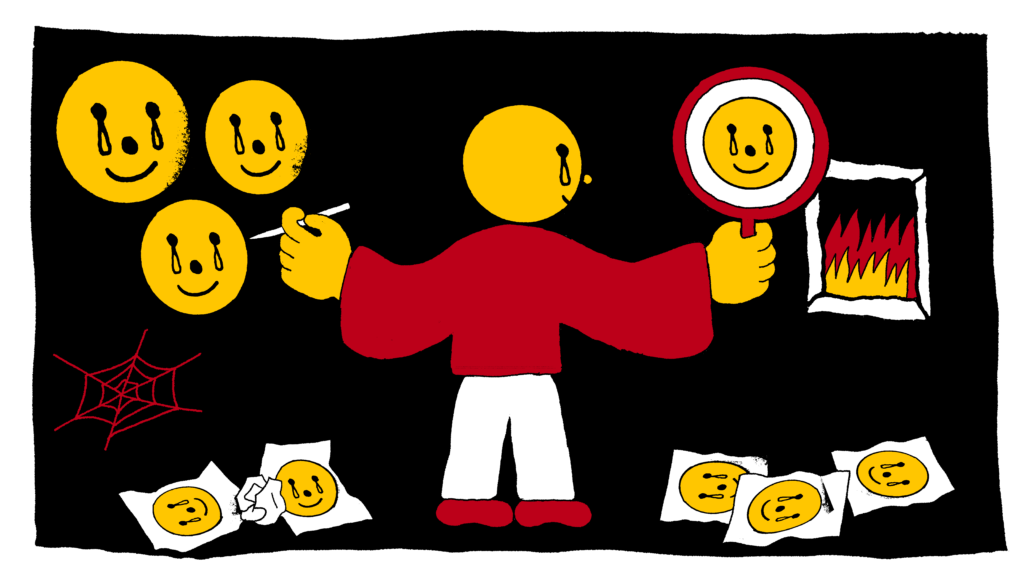
I found looking into this archive both vertiginous and clarifying. I excitedly texted Jody and Noa every time I read something else that felt like it could have been written today. Their responses were always so sharp, and I usually reacted with the emoji that is crying laughing, or laughing crying.
—Amy Ching-Yan Lam, October 2025