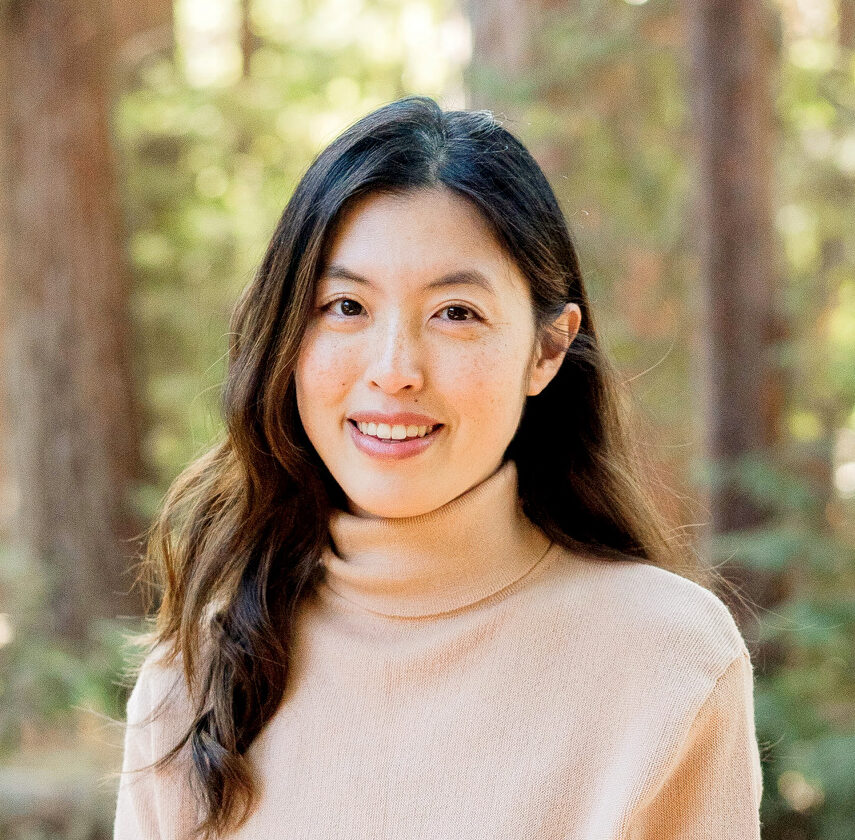

Adela Wu was one of our Fall 2025 Digital Residents. As a part of this program, we do Q&As with our residents to feature them, their work, and their words. See our Q&A with Adela below, and explore more Spotlights here.
TSW: Tell us about your work, writing, or project. What are you writing these days? How is your work changing, and how is it changing you?
Adela Wu: I tend towards writing and reading creative nonfiction in all its wonderful forms.
All the varied parts of my identity — as a second-generation Chinese-Taiwanese-American daughter of immigrants, a physician, a mother, a daughter, a writer — surface and coalesce in my own creative work.
My current, main project is revising a book-length hybrid memoir about grief, my father’s decade-long decline from brain cancer, the Chinese diasporic experience, and training in the male-dominated field of neurosurgery as a Chinese-American woman. Undertaking this endeavor has inspired multiple offshoots and smaller creative projects; I’m currently outlining and writing a few personal essays derived and developed from subthemes of the memoir. Some other book-length ideas that I may tackle in the future include a popular science and public health book about aspects of palliative and end-of-life care that are mired in misunderstanding; an experimental work about the overlap between motherhood and daughterhood; and, perhaps, more.
TSW: What is a question you’re asking yourself these days, and what is a question you or your work is asking of your reader?
AW: To me, the act of writing creative nonfiction poses several big questions of myself, questions that are ever-present and guide the direction I may take with my writing. Am I the right person to tell this story? In this work, when am I a character versus the narrator? Which versions of myself appear within the lines?
There is a vein of implicit trust within creative nonfiction. The reader enters an unspoken but understood covenant that there is a foundation of truth despite all the natural fallacies inherent to memory. The only real heavy lifting I ask of my readers is to consider the question: What bigger truth(s) is this piece of writing excavating for you?
TSW: What’s a mantra or motto that you have in mind these days when you are writing or creating? Is there a writing routine or ritual that keeps you beginning?
AW: I confess I’m not great at keeping track of quotations that move me. But, recently, I finished Katie Arnold’s memoir, Brief Flashings in a Phenomenal World, in which she wrote, “I learned to write not to make something happen, but to find out what happens — to write my way into knowing,” a sentiment that almost perfectly captured what I found writing creative nonfiction becoming for me: an exercise in knowing and understanding my place in the world, in my past, in the present. And so, I also realized that I had subconsciously been “writing into knowing” since I was six-years-old, when I was given my first blank journal to keep as a personal diary. What changed by now was that, while I still keep private journals, I also sometimes choose to write for a public audience.
I’m also not great at keeping a writing routine, among the other competing obligations I have in my professional and personal life. When I write and read, I do so during odd hours, while I’m not at work, after dinner, and while my toddler sleeps. I frequently write facing a wall, even though I would prefer to sit by a large window overlooking nature. Sometimes, my daughter wakes up and wants to climb into my lap and type on my computer, too. Sometimes, the writing process is messy, and the writing is, too, but I’ve grown to accept all that is still part of the art.
One last thing: technology can be both a nuisance and a gift. I still enjoy the analog, and there is nothing quite like writing longhand in a notebook. But, smartphone apps, like iPhone Notes and Notion (which I used to answer these questions), make writing and jotting thoughts and potential ideas so much easier, more accessible, and immediate.
TSW: What is something that someone said — a fellow resident, a past mentor, perhaps something from one of the bonus sessions — that helped change the way you see your writing or work?
AW: “Not all writing is writing.”
In many areas of my life, including my career, I’d grown accustomed to treading and being sucked into the productivity spiral. I’d even carried this mindset to my creative writing practice, believing that I needed to hit a specific word count or a page goal in order to call my writing session a success. Someone in my Narrative Shifts residency cohort said that “not all [of] writing is writing.” That simple phrase was a permission slip to engage with my creative practice with an entirely new perspective. These days, I’m trying to be more mindful with reading, thinking, learning craft, and supporting and cheerleading other writers.