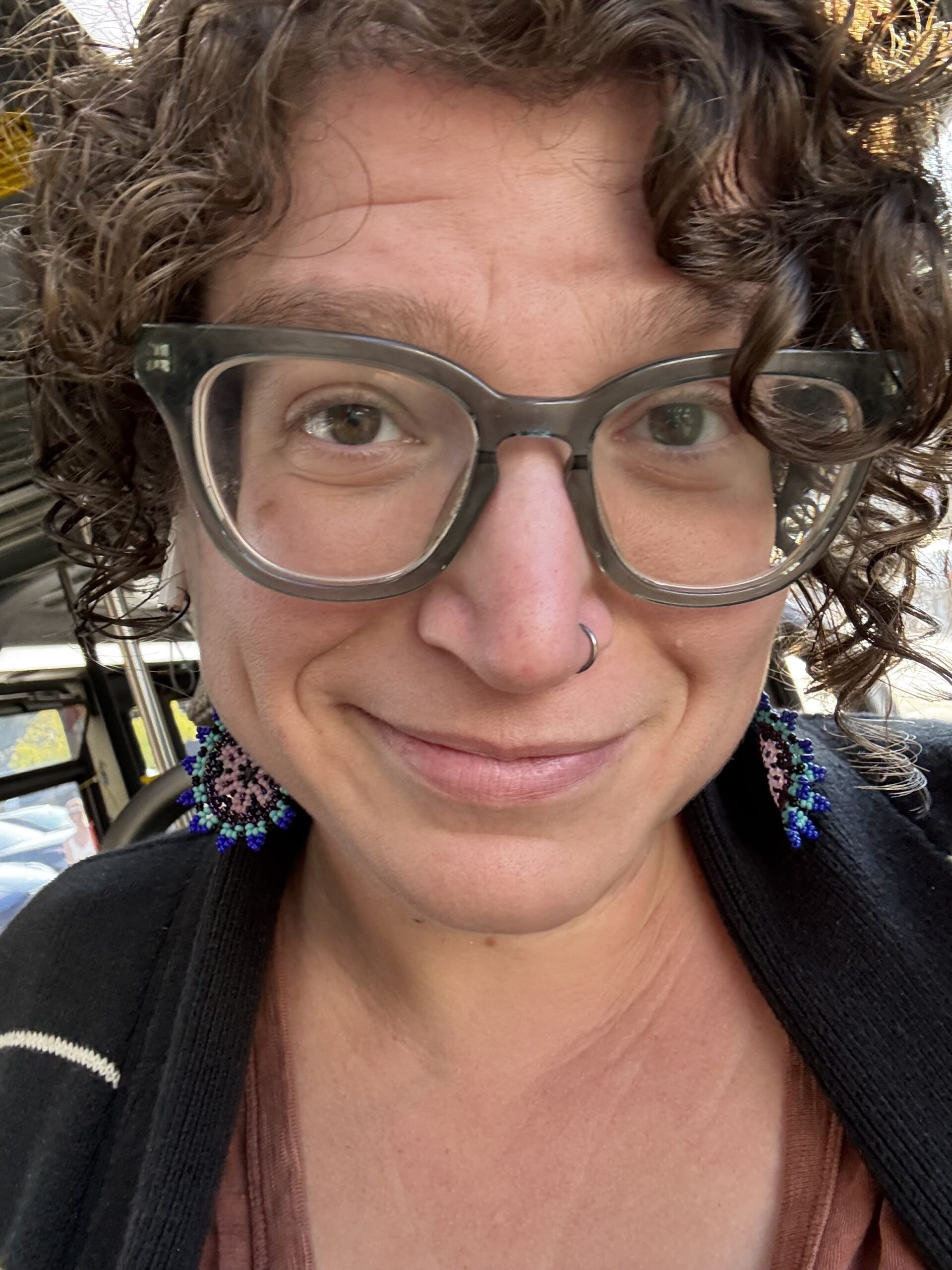

Raphaela Weissman was one of our Fall 2025 Digital Residents. As a part of this program, we do Q&As with our residents to feature them, their work, and their words. See our Q&A with Raphaela below, and explore more Spotlights here.
TSW: Tell us about your work, writing, or project. What are you writing these days? How is your work changing, and how is it changing you?
Raphaela Weissman: I’m working on a collection of connected short stories — story cycle? Novel in short stories? — set at a fictional East Coast women’s college in the 1950s.
Someone asked me recently how to write fiction without the characters all being you. I think there’s no way to get around my characters all being me, but they can represent and express different sides of me. All the women at this college, in their late teens and early twenties, are going through their own personal hells, and triumphs, and certain that they’re going through it alone. Maybe combining them all together with my own narrative voice is my way of screaming down at my younger self from on high, “You’re not alone!” And of course the cosmic joke of it is that I still, at forty, manage to feel alone in whatever it is I’m going through, but — how is this writing changing me? — maybe it’s moving the needle a little towards finally getting it.
TSW: What is a question you’re asking yourself these days, and what is a question you or your work is asking of your reader?
RW: Can being smart, complicated, angry, wise, and honest ever make up for the pain of a crush not liking you back? Can those qualities protect us from loneliness; can they keep these young women company while they sit alone in their dorm rooms on a Friday night when every single other person around them (it seems) has exciting plans? In the 1950s, can any of these young women’s inner strengths or experience ultimately mean anything if society has such specific expectations of them? Now it’s 2025; is it still a revolutionary act for a woman to have ugly thoughts, anger, desire?
TSW: Who do you bring into the room with you when you write, and/or, who do you consider your work to be in conversation with? Who are you writing for?
RW: I think of fearless, dark midcentury women writers, like Flannery O’Connor, Carson McCullers, and Shirley Jackson. These women’s characters are brilliant and vicious and bracingly honest in the worlds they share with us, while often walking through life scared, anxious, frustrated, and repressed; they feel ugly and unremarkable. Shirley Jackson is my primary muse for this collection. She paints a world that keeps turning in spite of you, in defiance of you; a world that’s too busy to care about your feelings or guarantee a soft landing.
I am writing this, of course, as always, for every crush I’ve ever had, men who have rejected me, and kids who were cooler than me in high school.
TSW: What were you processing during our residency program? Did anything unlock for you? If so, what new entrance did you find for your work or for yourself as a writer in the world? And what caused that shift?
RW: My extremely impressive, smart, thoughtful cohort were serious writers dedicated to their craft, and they were intimidating. I had to shut my impostor syndrome up so that I could pay attention. I had to honor my own voice, what I bring to the table, and I had to lean into it. We’re all trying to get at the same ugliness and truth, ultimately, though we take different routes through our writing to get there. I think I gained a new appreciation for my own particular angle.
TSW: What’s a mantra or motto that you have in mind these days when you are writing or creating? Is there a writing routine or ritual that keeps you beginning?
RW: I’m currently in grad school, getting a Masters in Counseling; I must keep writing prose so as not to let academic writing consume me! Sometimes I’ll work on this project, or some other “creative” writing, to cap off an hour or two of paper-writing, to keep my muscles primed.
I have a playlist of music from 1954-1956, music my characters would have been listening to, which I always play while I work on this collection, so the mantra in my head is Elvis, or “Papa Loves Mambo.” My favorite is The Chordettes’ “Born to Be With You,” which I sometimes play on repeat.
TSW: What motivates you to keep beginning, and/or, what is a story that gave you permission to tell yours?
RW: I’m fighting the good fight to keep reading for pleasure as I’m in grad school, which may be a folly. As my Counseling program inundates me with reading, it simultaneously hammers away, aggressively, at the importance of self-care, so if you think about it, I have a responsibility to keep reading fiction… right? Women writers have especially had a hold on me recently. I just took a master class in connected short stories by (finally) reading Elizabeth Strout’s Olive Kitteridge. Recent favorites that I’ll revisit soon include Olga Tokarczuk, Jessamine Chan, Mona Awad, Banana Yoshimoto, and Lily King; and Grace Paley, Gloria Naylor, and Kathy Acker are three I haven’t read yet but are high on my to-read list.
TSW: What is something that someone said — a fellow resident, a past mentor, perhaps something from one of the bonus sessions — that helped change the way you see your writing or work?
RW: Years ago, Julia Slavin told us all on the first day of our workshop that you can’t be a writer until you answer the questions, “What is the worst thing you’ve ever done to another person?” and “What is the worst thing someone has ever done to you?” Wherever I land as I roll those questions around in my mind and debate whether they really are the most necessary for writers to consider — sometimes I think that yes, they absolutely are! — they will always, always, always be my answer to questions like this one, for the rest of my life. I’ve got to hand it to her for that.
Since Seventh Wave’s residency was multi-genre, which is pretty unique, I was fascinated to hear about the great distances between the experiences of writing poetry vs. memoir vs. fiction. Poets seem to be as mystified by my writing process as I am by theirs, and say that they can’t imagine doing what I do, which floors me as someone who has not attempted to write poetry since I was a teenager. We should all be really impressed with each other!